Showing posts with label goals. Show all posts

Friday, March 25, 2016

What Happens While You're Making Other Plans

 
You know the saying life is what happens while you're busy making other plans. It defines my relationship with long term planning. Yes. I need a plan, it provides direction without being as bossy as the GPS in my car. Plans, for me, have to be loosely held otherwise all life gets crushed out of them.

Owning the boat we do and living aboard it were long term plans that came to fruition. Publishing - also a long term plan that worked. Sorta. In true plot-twist fashion, nothing quite works out the way you'd envisioned. I'd imagined a long string of scifi titles to my name by now. Instead, the publisher asked for anything that wasn't scifi. Well okay. There's that bossy GPS after all, yelling at me that I'm taking a left NOW into other genres until I find home.

The reason the cat in the sunbeam is up there is that he illustrates one of the finer points of long term planning. Every single one of us tucks our hopes and ambitions and drives into our goals. Those goals reflect some of the finest points of our aspirations for ourselves. And then the universe hands us a situation that shows us that our priorities weren't what we thought they were. Or maybe I'm just a terrible planner. Point is, the elderly gentleman above has set his paws on his path out of this life. It's a long slope for him, one that could take another year to two years, if I'm lucky. The trade off is that I'm on call for him 24x7. Medications. Shoveling food into him. He cannot be left for more than four hours at a time. I understand it's a little like having itty bitty kids - cause he gets me up every few hours of the night to tend him. And not a bit of this was factored into my long term plans. Any plans, really. Sure. I still have long term plans and I am still working toward them. But let me stress how this guy getting sick utterly altered what I believed were my priorities.

Most of us think we understand our priorities. I'd submit that we don't. Not entirely. We're human and we operate from a particular blindness that assumes everyone and everything we love will remain the same - unchanged. Forever. Intellectually, we get that's not true. But until the severe mental illness strikes you or one of the people you most count on in the world, until that panicked midnight emergency run somewhere with someone you'd trade places with in a heartbeat, your priorities haven't been put to the test.

Every one of us are going to run into bumps in the long term planning road. It's why I've learned to hang onto my plans loosely. Because when life happens, it sometimes pays to examine your fistful of plans and cast aside any that no longer make sense. Once you've done that, though, the vital thing is to keep going. Creep toward the goal. Crawl if that's what you have to do. Just keep moving in the direction of the dream. Whatever it may be. That's where you'll find me. Out there hobbling along my road, muttering at my GPS to shut the fuck up.

Friday, January 8, 2016

How to Tell If You're in a Toxic Relationship (With Yourself) - Or My Goal to Exploit Clickbait-y Headlines

Goals.

I suppose it's good to have them, but I can't help but feel that our (US) culture has a pathological, toxic obsession with goals - a hold over from our Puritan cultural roots that shouts guilt and crazy-making exhortations at us all.

DO MOAR
BE MOAR
YA LAZY, SINFUL, BROKEN BASTAGE

What? Only me? Yeah, I didn't think so. Well let me tell you something. You're fine. Exactly the way you are. Whether you feel tiny or shredded or possibly shattered. It finally occurred to me recently that human beings are only perfect when they are imperfect. It's only through the cracks that our souls shine through. It's from our places of vulnerability that we make the most meaningful and lasting connections. And if you create anything - art, cakes, a home, a family, anything at all, your hurts and regrets and shame are powerful fuel for that art. Not so say that joy and love aren't powerful generative forces, too, they are - but they come after you accept every aspect of yourself. Newspapers and magazines offer up a lot of click-bait-y headlines in January: HOW TO TELL YOU'RE IN A TOXIC RELATIONSHIP. If you read through the lists of signposts, you may nod your head sagely, glad you aren't putting up with any of the verbal, mental, emotional, physical abuse of a toxic relationship - but have you tried applying those signposts to your relationship with yourself? I'd fail. Would you? Most of us don't want to be abusers and we'd sooner the ground swallow us up than hurt someone that way, yet we never bother to evaluate how we treat ourselves.

So if there are goals for the new year, let them these:
  1. Pledge to be gentle with yourself - adopt a policy of nonviolence in thought, word, and deed concerning yourself. Seriously. Just listen to how you think at yourself. You will be horrified by what you hear.
  2. Make time and space for doing nothing at all. It needn't be much time. Fifteen minutes a day. Not for meditation. Not for reading. Not for yet another course on how to do or be The Thing. To do nothing. Most of us have forgotten leisure and how to be alone.
  3. Vow to help someone else. Whether you volunteer on a regular basis or just offer a cup of coffee to the homeless kid on the corner once in a while - totally up to you. But if you want the cure for a bad day, bring a smile to someone else's face.
Goals can be a fine thing. You can't get to a place if you don't even know it's where you want to go. Just don't hold on to goals so tightly that you can't take a detour to see the sights. They aren't supposed to be used to flog yourself with. This isn't the Dark Ages. There is no widespread plague calling for parades of penitents flogging themselves to drive off the scourge. Unless, you know, you're into that kind of thing. Then by all means. Make that a goal and flog away.

Friday, November 6, 2015

Mapping Your Progress

Let's pretend you want to drive from the east coast of the US to the west coast. And you don't want to leave a mote of rubber on a freeway anywhere on that epic journey. Chances are pretty good you're going to need to have a good look at a map. Unless you're into hopping in the car, getting on whatever old road without knowing where the gas stations and rest stops are so that you end up dead in a swampy ditch somewhere. To get from sea to shining sea without ending up in your own personal Deliverance reenactment, you're going to need a plan. A map. A course plotted and laid out so you can follow it or deviate from it based on conscious decision, not happenstance.

Writing is the same. The path between the beginning and the end is fraught with peril, scenic byways, speeding freeways, and crumbling back roads choked with alligators. Unless you have a goal, you're venturing forth into the country of your storytelling without a map. You can't get where you want to go if you don't know where you're going in the first place. Someone said that, I'm sure. It was probably pithier before I got hold of it, too. Okay. So you need a goal. Fine, you say. Goal = write the thing. Now what?

Now you map out a route. Whether it's via an outline, a plot sketch, a synopsis, or a loosely held notion of A happens, then B, then C, you must be the GPS for your story. Our destination lies yonder, therefore, we will get there via this plot twist over here. We'll stop and stare into the abyss at this point before pitching the characters off the metaphorical story cliff. Yay!

Then. Then you have to drive.

Until someone invents that teleporter, or a room full of monkeys spontaneously generates Shakespeare, the only way from beginning to end is to put in the hours - whether driving or writing. Here's the thing. On the west coast, if I want to get from Seattle to LA, I can take I-5 or I can take 101 down the coast. 101 is gorgeous. And winding and slow and jammed with logging trucks and motorhomes. It takes days. I-5 is FAST. And some of the brownest, flattest, ugliest stretch of freeway available in the United States. Some days, it's worth going fast. Some days, it's not. Stories are the same way.

 
YOU pick the route. You pick your sights. If you're writing, and you aren't having fun, why are you doing it? Change course. Go faster. Or, if you're going fast, get off the freeway and take the coastal road. Slow down and take in the metaphorical sights of your story.

Your journey is just as important as your destination. Enjoy it. If you aren't enjoying it, change it until you are. Reaching your goals is a lot easier when you're having a good time.

AM Update: You know what? There's more to this. Look. You know how to set goals. We all do. Sure, sure. If you need help setting realistic goals, Google that. The techniques for SMART goals are all over the interwebs. Avail yourself of them. But when it comes to making tracks, to actually doing the work, there are a couple of tricks you can use.
1. Immersion - keep your head in the story. When you close your eyes at night, put yourself in the story where you last left your heroes and play through scenarios until one tickles your fancy. Keep a notepad beside the bed.
2. Front load the work - at the end of each writing session, I take a few long hand notes about where the story wants or needs to go next. There may be notes about a scene I missed and want to add. Whatever.
3. Treat the writing and yourself seriously. When you sit down to write, clock in. Keep a notepad, spreadsheet, or whatever works for you. Write down when you start writing. Not when you turn on the PC and start surfing FB. When you start writing. Every time you lose focus and stop writing, jot down the time and your word count. Note what distracted you. 'Need tea', 'bio break'. Take 5. Then sit back down. Write down the time and get back to work. You're developing a data set about what bumps you out of the work so you can tweak your environment to support your focus.
4. If you get stuck it's because you don't have a plan/don't know where you're going. Take 10 minutes and free flow with pen and paper on what could happen next in your story.

There are more, but these are the start of 'how to keep to word count per day' goals.

Thursday, November 5, 2015

Sticking to the Goals

So, now that I've gotten through October, I've got a few things of my plate. Namely, the proofs for The Alchemy of Chaos have been finalized, and I submitted the final draft of An Import of Intrigue.  Which means now all I've got to work on is rough draft stuff.
I've mentioned before that when I'm in drafting mode (which is just about always), I target 500 words a day.  I often surpass that, but 500 makes a good target for me.  It's a not a breakneck finish-a-novel-in-a-month pace, of course, but it works best for how I write.  I tend to be very deliberate in how I write and plot, so the pound-it-out-and-fix-it-later method does not work for me.
But what I need to do-- what every person who has the intention to actually write a novel needs to put their ass in the chair (or their feet on the floor, if you've got a standing desk), and just plain do the work.
The work itself is not the sexy, exciting part about being a writer.
I say that because I notice there's a certain class of hopeful-novelists who don't want to write, they want to have written.  They want a shiny book to point to, and the work is something they kind of gloss over.  There's a certain ginormous best-seller who speaks of the process of writing their first novel like it was some kind of unintended wacky accident, that they were just typing away and *novel occurred* out of the blue.  No.
The process of writing a novel cannot be expressed in the passive voice.  You've got to actively decide, each day, each week, that you're going to get it done.
Speaking of, I've got quite a few things percolating, above and beyond the third Thorn novel and the Space Opera in Progress, so I need to get to work on that.
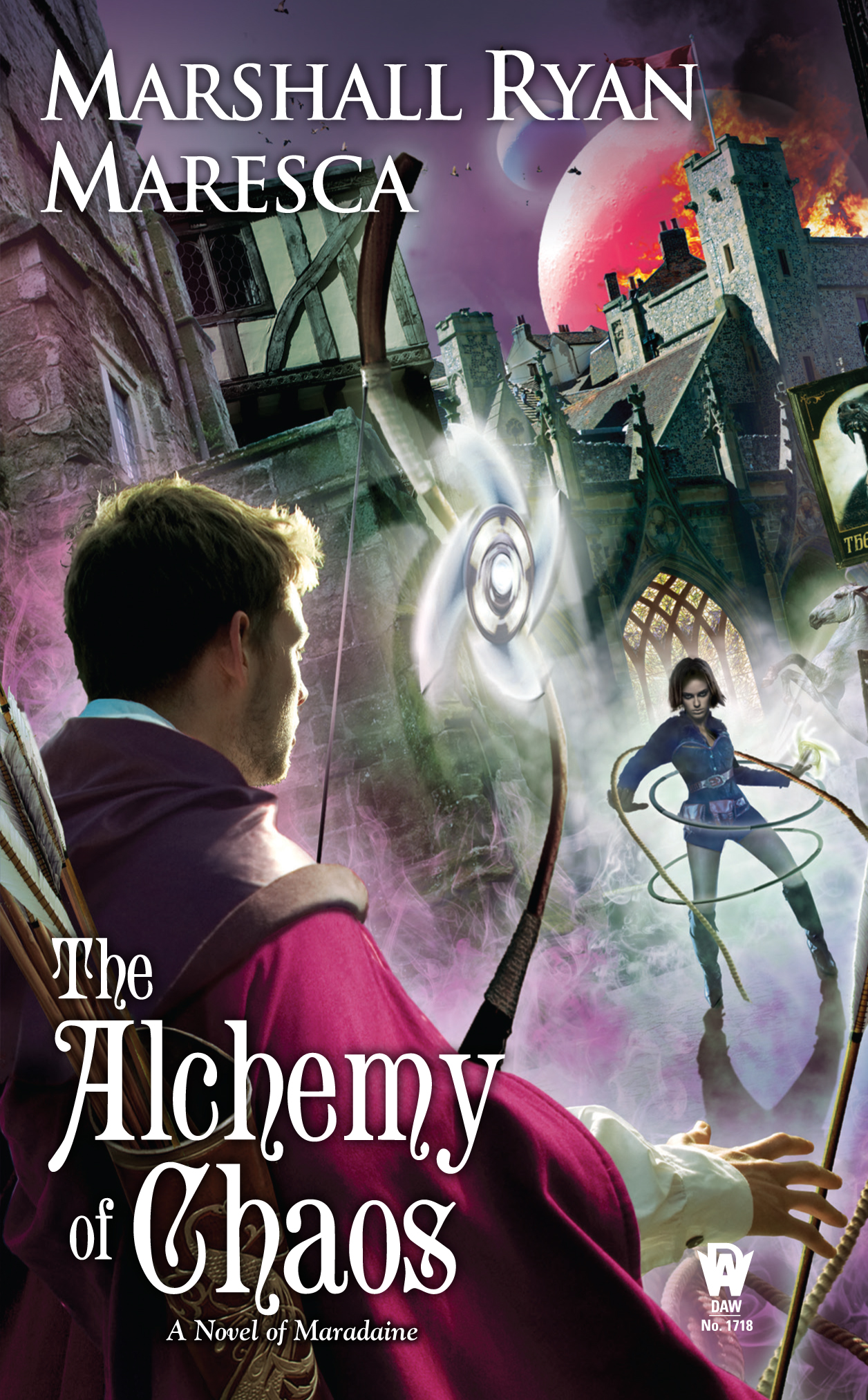
But not before sharing this big news: The Alchemy of Chaos has a cover!  The fine people at SFSignal shared it with the world, and again Paul Young has done me right.
The Alchemy of Chaos final front cover
Check out The Alchemy of Chaos over at Goodreads.

Friday, January 2, 2015

New Year Resolutions Writer Style

Welcome to the second day of the New Year. Hopefully, the hangover has worn off by now and you're staring at the list of resolutions you scribbled whilst judgment impaired by the adult beverage of your choice. Yeah, I don't (can't) drink, either, but work with me. I need an excuse for looking askance today at the unreasonable promises I made yesterday. The first item on my list: Move to Hawaii. Lovely thought. It misses a really vital step: Win the lottery. Because that is the only way I'd be able to afford a move to the islands. The second item on the list: Learn to love the cold is just laughable. A couple of years in Iceland when I was a kid cured me of cold forever. All I do is whine. Is it too much to ask to live someplace where making contact with the toilet seat isn't akin to planting my tender butt on a block of ice? It's 21 degrees outside and one of the radiators died a cowardly death. It has yet to be replaced because who wants to go outside in this nonsense? Which brings me to my next resolution: Go cold turkey on complaining. Yeah. Banner start to the resolutions.

Kidding. Don't do resolutions. I prefer goals. Minor difference of semantics, maybe, but resolutions seem so absolute. Goals get broken down into actionable steps. And when we talk about how my writing will change over the coming year, I can talk about how I aim for deeper POV, characters who follow you around your house for days after you read their stories, and maybe even a little angst, they're goals I really can't measure or control - they're a learning process that will take whatever time they're going to take. What I can control are these:

1. Finish what I start. No. You don't understand. This is a serious thing for me. I started five things this year. I finished two. Wait. No. I started eight things this year. Finished two. Sure. Those two things were novels. But seriously. That start/finish ratio? MUST get better. (The measureable goal: The equivalent of three novels this year. I'm asking myself for 300,000 finished words this year - first drafts accepted.)
2.z <-- This was the cat's input. One thing I can safely say won't change? Feline editorial input.
MY #2: Genres. More of 'em. We've got yer scifi, yer urban fantasy, yer sword and sorcery, and coming soon to a venue near you, contemporary romance and possibly historical fantasy. Already underway. Assuming proposals don't get kicked back in my face accompanied by the music of mocking laughter.
3. Finishing that which was started many long years ago. I started with scifi. I got stalled in the middle of a series. That series wants to be finished. Book three is half done. It's rattling its chains in my dreams at night. So it looks like this year will be a form of old home week. All year long. (The measurable on this one is a completed book three. It will count as one of my three novels for the year IF I get it done the way I want.)

Do you set goals for the new year, writing or otherwise? Why or why not? What helps you stay on track? That's, you know, legal.

Friday, November 22, 2013

Know Thy Word Count


I seem to be taking on the roll of contrarian (or devil's advocate, if you prefer) in the bordello. Because, quite frankly, word counting beyond the basics (of I wrote x number of words today) is a little too much like clock watching for me. It's stultifying. It indicates that something's wrong in my scene. I mean, the ideal is to get lost in the flow of brilliant prose. So maybe, on reread, it isn't as brilliant as all that - but you know what I mean. At least it's on paper, right? Who doesn't want a couple of hours to zoom by leaving you several thousand words richer? It's the perfect world scenario.

Tell me true, though. How often does it happen to you? Not often enough? Yeah. Me, neither. We aspire to an ideal that may only be achieved upon rare occasion. Of course, the only way to approach that lofty state is by showing up at the keyboard as often as possible and laying down words. No matter how tortured.

Sadly, counting (and subsequently keeping track of) words written is about the only objective metric we have available for measuring progress on a WIP. It's useful for deadline management and for knowing how long you take to write a solid book. If it is true that the writer should indeed know him or herself, then you need to know how many words a day you're most comfortable writing. Note I don't say 'capable of'. 'Capable of' has a high burn out rate. And the one thing word count can never tell is whether a novel is any good. At all. Sure, we all have good days and bad days. Some of us produce much better prose when we're forced to go fast. Some of us crumble like stale oatmeal cookies when the pressure's on. Know which one you are and then let me know. If there are cookie crumbs, I'm going to want tea.

Where was I? Oh yes. Know thyself. Know thy process. For example, I know I'm a pantser. I know that I start a project quickly, slow to a crawl through the middle, and then ramp my writing speed as I close in on the ending. I know I draft almost exclusively in dialogue (read that as 'all talking heads, no action') and that this annoys me.

But also? Know that you can change. You can change you and you can change your process. You aren't likely to change core issues - if you're a plotter, you'll probably always be a plotter - that's how story makes sense to you. But let's say you have the opportunity to leave a day job and begin writing for x hours every single day. If you're already keeping track of your writing habits, you have a base upon which to build. If you only have a few stolen moments per week to write but you'd like to step up your output? You have to know where you're starting before you can begin stretching your limits. Yes. That's what I've been doing for myself - stretching. Pushing my limits. Hence a few books and articles on productivity that Jeffe alluded to early in the week.

So here, for the curious are my goals.
  1. Write every day for four hours per day
  2. Write at least 2k words per day
My actuals? I don't get to write every day. Migraines do not permit that. They steal about four days a month when I'm lucky. When I'm not lucky . . . let's just say the month of October 2012 was a real downer. Just about any other illness can be written through (in fact, writing while loopy with flu has some benefits - but only in the drafting stage because writing with a fever ensures you'll need to correct a bunch of really entertaining mistakes). It is incumbent upon me to plan for migraine days and factor those into my production schedule. The four hour time commitment isn't a problem. It's first thing in the morning when no one I know wants to be awake anyway, and the rest of the day is dedicated to the family and mastery of the mundane. So there's very little resistance on the home front.

Tracking takes place in a shared spreadsheet. A couple of my critique partners and I enter our *supposed to be* daily word counts. This is not my favorite thing on earth. The nanowrimo.org site, has another tracker where you enter in how many total words you have in your WIP. (If like me, you write in different docs depending on scene, you have to keep track of how many words you wrote toward your quota, then add that number to the nanowrimo word count.) The nano site then provides a word count breakdown based on how close you are to 50k words versus how many days are left in the month. I find it satisfying. Maybe because I didn't have to design, program, or maintain it.

As for 2k words per day? My actuals come really darned close. Some days, I get 5k. Some days, I get 1k. On the 1k days, I know I've got a problem in the story line that has to be resolved. That requires an hour or more of notes about the story in the evening - immersion into defining the issue so I can fix it the next morning during work hours. What am I capable of? 8k per day for several days straight - but only at the end of a book and the error quotient will be high. It isn't where I'm comfortable, though. Equate it to training for a marathon. I have to log a bunch of slow days before I can log a couple of fast days. My writer brain needs contemplation time and different brain wave states to ferret out continuity issues, motivational inconsistencies, and such in a story.

I love Jeffe's spreadsheets and graphs. For her. They do exactly what she needs - quantify progress and provide benchmarks. I can't use them. Tracking my work to that extent becomes an impediment to me actually doing the work. Do your job your way. There's nothing wrong with it. Unless you discover your way isn't working for you. And the only way you're going to know and/or change that, my friend, is to start counting and keeping track in a way that makes sense to you.

Friday, September 6, 2013

The Disorganized Word Whore's List

How to managing multiple projects? Anyway you can. I don't say this to be cavalier. I say this because I'm the organizational polar opposite to Word Whore Jeffe. Spreadsheets are instruments of the devil. But like Jeffe, I dislike crunch time - those last minute pushes to complete something. The curse is that I'm good at crunch time. The problem? It comes with a price and not just one that impacts me. My family pays, too. And that's not fair. So while I'm pathologically allergic to spreadsheets and a particular type of organization, I do my damnedest to be the tortoise, NOT the hare.

The Less Organized Word Whore's List for How To Manage Multiple Partne. . .Projects:
1. Ritual - create a place where all you do is work on writing. I admit I get a little anal about it. Same begin time, same end time, same place, same chair, same tea. It's a great big hand reaching into my brain to flip the switch from 'the rest of my life' to 'creating now'.

2. Goals - Know what you want and when you want it by. Here's the big thing I struggle with - I'm good for a promise I make to other people. I am not quite as good with promises I make to myself. Why is that? What message have I absorbed that makes me less worthy of keeping a promise to? If you're not keeping the deadlines you set for yourself, this may be your issue, too. Examine it. Figure it out. Fix it. Recruit professional help if need be to work through that. This is the one place where those evil spreadsheets seem to help. My CPs set up a shared spreadsheet where we all input our daily word count goals and then what we achieved. Something that simple has made it easier for me to keep track of when and where I'm failing to keep my promises to myself. I can subsequently get back on track.

3. Lists - Usually, when there are multiple projects to be managed, the bulk of them are in my non-writer life. There are cats to get to the vet. Parents in hospitals (two this past week - it's been a messed up week - both are fine, thanks.) Groceries to get, gas to put in cars, doctor appointments, bills to pay, clients to call. But occasionally, I'm trying to get word count on one book while an editor is awaiting rewrites on another book. My lists go by the week - Monday to Sunday. So as a list of deliverables grows for the week, I can see at a glance whether I have the bandwidth to ADD extra hours at the computer for the rewrite, or if I have to set my word count goals aside. Something I can easily do because while Jeffe's 'Half Again' rule is excellent, I liked the Star Trek model - you know - Captain Kirk asking Scotty if he always inflated his work estimates by a factor of four. Scotty answered that of course he did - how else could he preserve his reputation as a miracle worker?)

So far, this system has worked well, even as I work to increase my productivity on a slow, steady basis. Granted, I have a prioritization system, too, one that resembles KAK's but it's much shorter. 1. Keeping life in the living 2. My sanity 3. Everyone else's sanity 4. Everything else in the world is gravy.

The prioritization system gets applied to everything on my list. Amusingly, vacuuming on a regular basis is a P1. Cause if the floor crunches beneath my feet? Someone's gonna die. But look. Writing isn't a priority 1 in my system. It's a P2.

I *treat* it like a P1 as long as I can, but when the phone calls about the parental medical emergencies came in, I could drop my writing schedule back to P2 and deal with the family issues. By treating writing as a P1 when I can, I develop a habit. Something that's easy to get back to so I can pick up where I left off in a story. Or a rewrite.

In the end, I think back to acting school and something my teachers all said. "If you can do anything else besides acting, you should." It turns out, I *could* do something besides act. Lots of things, as it happens. But the one thing I can't NOT do? Write. Even if I never published again. Even if no one ever read another word of what I wrote. The stories have to escape the confines of me. If they don't, I'm only half living.

If the stories start to drown you, too, when you aren't writing, then it won't matter how many projects you have going concurrently. You will find a way to juggle them all. Your sanity and your life may depend on it. I hope you'll tell us how you do it. Coping skills enrich us all.