Showing posts with label series. Show all posts

Tuesday, September 8, 2015

Wrote a Series, Forgot the Details: Series Bibles

The fastest way to be crucified by your fans is to contradict the characters, the relationships, and the world you created. Maintaining a series bible is a common way for authors to keep their whosies and whatsits sorted.

Some truly motivated authors start with a blank journal then go all scrapbook queen on it. From 'zine clippings to fabric swatches, there is no detail uncatalogued. Hell, they even paste calendars, perfume samples, and recipes in there.

Opting for all the conveniences of tech, there are those who have turned Pintrest into their series bible. The uber visual site lends itself to using reference images to map their worlds and peeps, plus it allows the author(s) to share it with their fans.

Then there are those supremely analytical authors who create Access Databases with tables and queries (the other kind of query). The series as a constantly growing beast has every bit of minutiae recorded, tagged, and logged. Book, chapter, page number and paragraph.

Me? I'm a mid-effort sort of tracker. Since I outline my books, everything I need is in that primordial Word doc. One doc per book. Easy copy and paste from one book's outline to the next. Additions added as bullet points under the headings and sub-headings. Score one for Team Plotter.

Here's an example from my Spring 2016 release NIVURN:

Challenges of Environment:
£  Challenges: Terrain = The ground is frozen solid, permafrost. It is all ice and snow on the surface.
o   Burrowing down to the magma layer is highly risky and hazardous. The permafrost is stable but unyielding cold. Below that is silt, shifting and unstable. The ground caves in with any type of digging. 
o   There are short willow trees and plants that grow horizontally in the thin “melt sheet.” These feed the herbavores.
o   The coast of Nivurn is littered with thermokarsts – marshy islands amid the thawing permafrost caused by the tides of the Pogichan Sea. At high tide, the buildings are on silts and seem to be house-ships on the sea. 
£  Challenges: Food = Vadrigyn eats rocks. In a frozen tundra, there simply aren’t any. She’ll have to harvest/steal them from others. It makes her highly predatory.
£  Challenges: Weather = She’s a fire-child; she doesn’t do cold and wet. It’s actually detrimental to her body.  The longer she stays in Nivurn, the weaker she becomes.
£  Challenges: Shelter: Tents (migrant) or igloos/ice villages (stationary).


Friday, August 28, 2015

Series Theories

What elements make for a successful series? I'D SURE LIKE TO FIND OUT, cause ya know? Neither of my series actually got to BE serieses (what is the plural of series??) to completion.

<RING RING>
Hello?
<Ms. Burnard? Bitter calling. Line two.>
Right. Right.

Ehem. Pardon me. Just gonna have this Snickers.

Ah. Where were we?
Series. Perhaps we can elucidate the elusive nature of the beasts by examining those aspects which deterred us from reading through other authors' works.

1. Top-That-Itis: Dreadful disease that fells many a promising series by forcing an author to reach deeper and deeper into the well of vast improbability for conflict. Some theories suggest that this tragic disease is what leads to that horrific event known as "Jumping the Shark."
2. Character Intellect Disorder: Characters afflicted with Intellect Disorder are easy to identify. Their authors spend great effort telling, and possibly, showing you how smart a character is only to have the character spend the rest of the series acting in a manner utterly inconsistent with that intellect. To put not too fine a point upon it, the character acts as if he or she has been clubbed suddenly stupid. This disorder may or may not accompany symptoms of Top-That-Itis.
3. Murky Motivation Mania: Some theorists contend that Character Intellect Disorder is nothing more than Murky Motivation Mania in action. *I* disagree, but the hair we split is fine, indeed. Any character can be forced to act out of character if properly motivated to do so. IE: a gun held to my head might indeed induce me to cluck like a chicken when normally, I would not. Anyone claiming the contrary is a fowl and dirty prevaricator. You see what I did there, yes? Ehem. However. One assumes that the moment I've dispatched the individual holding the gun to my head, I would revert to my true, uptig...er...sober mien. Therein lies the difference between Character Intellect Disorder and Murky Motivation Mania. The disorder appears as if a light switch had been flipped: Smart/Not. Mania manifests when a character acts out of character for no apparent reason and then just as mysteriously, flips back to acting as he or she always had.
4. Canon Fodder: Canon: A rule or law enacted by a competent authority. Alas, what mind among us can comprehend what madness besets an author who contradicts the rules of his or her creation as set out in the series as it first appeared? None of us. Not a one. We can only shake our heads in sad wonder and hope that Disney will redeem the franchise.

Come, my fellow series theorists. Regale me with your theories for what makes a series unreadable and that which makes a series eminently readable. I'll share the Snickers...

Tuesday, August 25, 2015

Top 5 Tips for Writing a Series


So, you want to write a series? Great. That's how I roll too.  Here are my Top 5 Tips for conceiving and implementing a series:

1. Define the Series GMC: What does (do) your protagonist(s) want? Why? What is keeping her/him/them from it? Ideally, each book in the series takes one of those large-scale conflicts and addresses it. Think of it as macro versus micro goals, motivations, and conflicts.

2. Continuous Character Development: As Jeffe and James noted earlier, your characters--all of the ones you carry forward through the series, from protags to tertiaries--must change. Some will grow stronger, some will fail miserably. All of them must experience stressors, strengtheners, and fractures in their primary relationships. They must have experiences that alter their dominant perspectives. E.g., Best friends in Book 1 may end up as arch-nemeses by Book 3. The cocksure warrior of Book 1 may evolve into a tremulous paraplegic in Book 2.

3. Contrasting Conflicts: Each book in the series should offer a markedly different challenge to overcome. Those challenges should spotlight a different aspect of your protagonists' weaknesses, and allow them to develop a new strength. The new strengths should needed to address the Final Conflict in the Final Book.

4. Know the End: There are two camps of series writers: open-ended series and close-ended series. I am a firm believer that every series should have an ending planned well in advance. As the author, you should know how many books it will take for your protag(s) to achieve their goals before you finish Book 1.

5. Determine Dependencies: This is where a lot of authors get hung-up. When crafting a series, you must decide if readers will have to read Book 1 to understand Book 2. That's your choice. There are no rules, no strong suggestions from on high. Then you have to decide how to move your series forward with the damages/lessons learned from the previous books without giving away the spoilers to the previous books. Whatever you decide, do not turn the first 50 pages of Book 2 into the Cliff Notes of Book 1. From a marketing/sales perspective, you want to give good reasons for a reader who picks up your series in the middle to go back and buy the previous books.

There you go, dear readers, my Top 5.  What would you add to the list?

Saturday, July 26, 2014

Ending a Series?

I have this photo, framed, on my writing desk!
OK, right off the bat we all know I have yet to write a standard series, let alone had to deal with the cancellation of anything! So I decided to answer this from the standpoint of a Reader, since I'm also one of those.

I LOVE discovering a new-to-me series. I had great pleasure when I started to read Nalini Singh, for example, with her various series, but especially the Psy Changelings which already had quite a few volumes when I found them. The fact that she then started the Guild Hunter series was icing on the already rich cake. Lora Leigh's Breeds were another series I arrived at when there were many books, which I hunted down so I could read every one.

It never even occurred to me that if I fell in love with a series, there might not be a resolution or a permanent HEA at the last volume.

The Dragonriders of Pern was another series that came to a wonderful conclusion and frankly as a reader, I was ready not to have any more, especially not more that were written by relatives. Biting my tongue about that.

These days I'm very cautious about starting a new series not so much that I've been "burned" myself by investing in something great and then never reading any more. But now I know how lucky I was with my early series-love. I've talked to enough authors who started a series, only to have the publisher pull the plug in the middle, around volume three, because the sales were lagging, never mind that core group of rabid fans. I've seen contracts where an author may not be entitled to the use of his or her own name, much less the characters and world they built, even if they desperately want to write more books in the series and self publish or go to another publisher. I've read enough reviews on Amazon how wonderful Book XYZ was but it ended in a cliffhanger (not even a Happy For Now but a genuine cliffhanger) and as yet there's no sequel on the horizon. Um no thanks. I'll wait over here.

When I was a little kid, the local TV station ran the old 1930's Flash Gordon movie serial episodes five days a week and I was too young to realize how broadly acted (nearly said hokey but definitely from another time in Hollywood LOL) they were, or that they were decades older than me...I just knew it was forever from Friday afternoon till Monday afternoon to find out how Flash and Dale and Dr. Zarkov were going to escape certain death at the hands of Ming. I don't wait well. Not full of patience. But at least I knew there would be that happy ending. I wasn't waiting in vain.

Until the station pulled the stupid kids' show that the Flash Gordon serial was shown as a feature with and I never got to see how they all survived on Planet Mongo. I.....was.....traumatized. For years. I've seen it now and I'm ok, thanks! Flash lives and he kisses Dale.

So where was I going with this?Oh yes, I don't invest my emotions in a new series unless I'm really sure there will be more books coming, or if each volume is standalone HEA. I don't mind the bigger plot arc being left open as long as the characters I care about get their HEA or pretty darn good HFN.

When I do tackle writing a series, hopefully in 2015, each book will have at least an HFN and the entire series will come to a satisfying ending. Not a spoiler, just the truth! you can quote me.

Friday, July 18, 2014

Plotting Terra Incognita

Since I've never wanted to write a series, I may be the worst person on earth to speak to plotting one. Because I don't. Sure. Sure, I have a SFR series. And now, an Urban Fantasy series. Neither of them started out being more than a single book each. Maybe it's a mental flaw of some kind. I simply don't think in arcs longer than a single novel. Everything I have, everything I am at the time goes into that single story. I'm down with the advice to hold nothing back for a later book. So I don't.

And then my editor says, "Have you thought about making this a series?"

This is one of those times when the acting degree comes in handy. I can act like I'm not clutching the phone, listening to the whine of my pulse in my ears. "Let me work up a few ideas for you," I say before hanging up the phone and succumbing to the urge to pound my head against a nearby doorframe.

It helped to realize there are two kinds of series: ones that follow a single, recurring character, and series that follow different characters whose story arcs are thematically related. I'd seen a lot of series with a single recurring character and I'd seen them go (in my opinion) totally sideways. I had long ago sworn I wouldn't fall into that trap. I simply wouldn't write a recurring character series. If you've read Nightmare Ink, you know how swiftly my vow fell by the wayside. The first series, the SFR, follows the arc of a war. Each book has a new hero and heroine. So at least for two whole books, I kept my word. O_o

Here's what it comes down to for me.
1. Did I think ahead and acknowledge a WIP could be a series?
    If YES: recurring character, internal arc possible
    If NO: different characters, external arc only

You've heard me talk about internal versus external conflict before, though usually as it regards a single character in a single book. In this case, Internal versus external conflict dictates what kind of series I can plot. A series with a recurring character most likely has a through line (across the entire series) that is internal to that main character - some emotional question that is bigger than one book can encompass. From the single character series I've read that I thought succeeded, it's clear the author thought that question out ahead of time and even if he or she didn't plot the series, per se, the high points were identified ahead of time.

The single character series I think flew into the ground don't have an internal arc - the authors use external arcs and events to keep their star moving. (Throw more monsters at the hero!) The problem is that without an internal arc for the character to follow, as more and more books get added to a series like this, the author seems compelled to keep trying to top the last story. This inevitably leads to shark jumping. It's never a good thing.

That's why, to plot a series, I don't actually plot. I figure out what I've got first. Is there an internal conflict or question that can propel my heroine through more than one book? If not, are there potential heroes or heroines lurking in my cast of secondary characters? Is there an external conflict that could drag several different characters through their own personal versions of hell? Once those questions are answered, I decide how many books I want in the series - usually based on how many characters I have available. The SFR is slated to be five books long. The urban fantasy - well - no one knows. Yeah. It's okay. I'll stop hyperventilating in a minute. In every case, I have a general end point in mind - a vision of how I want things to turn out. That allows me to begin coloring in the story between what has to happen to get the story from point A to point Z.

Plotting the internally motivated series boils down to using story events to challenge the heroine's core emotional question or issue. Don't be nice. Come at it from every conceivable angle. Let her win some. Let her lose some. The great thing about a series is that not all of the books have to end well. It's okay for her to fail. There's always next book for her to regroup and come at her issues again in a new way.

Plotting the externally driven series is about staying true to the arc of the action and fitting heroes to the action who will be most challenged by what the segment of action they face. The cool character idea gets axed if he or she doesn't contribute something emotionally interesting to whatever is happening in your world. It isn't to say there's no emotional truth in a series of this kind. There had better be. You still have to provide a complete character arc for each of the novels within the series. You have to end each character's story at the end of their book, that ending just has to serve the overall external arc.

Either way, my unorganized, unscientific method for plotting anything is a series of messy journal entries and then plucking the most interesting tidbits into a series bible document. The whole process is amorphous and subject to change since I am a pantser, myself, and I *like* to be surprised while writing a story. It does mean that it's terribly difficult to convey to anyone else how to do something that I suspect may be terra incognita - you have to get in there and discover it all for yourself.

Wednesday, July 16, 2014

Series Plotting


The Persephone Alcmedi series has six books so far. It was not planned at the outset.
In fact, I wrote up this awesome Johnny guy…6’2” leather wearin’ tattooed and pierced rock n roll bad boy while at the airport in New Orleans waiting for my flight home. Then I had that shrimp po’boy and tried to figure out who his ideal woman would be, yanno, since he couldn’t have me.

Persephone hit the page, took over, and never thought twice about it.

By book five, I was able to start telling his story from his POV. He’d been very patient.
And no, I don't recommend po'boys as a plotting mechanism.

Lemme back up...and address the topic a bit clearer.

When the contract came for VICIOUS CIRCLE, it was for a three book deal. Color me surprised. No agent, no warning, fairy godmother smacked me upside the head with a dream come true. (Thank you thank you thank you.) I’d of course tossed some ideas around in my head, daring to think about it but not really committing to it. Afraid to jinx it and all…
 
And then I had to come up with two more novel ideas, and tell the publishers about them.

Let me share a secret here. I can’t do short stories. Really. I envy those who can conceive an idea and work it open to close, concisely, done, a short story. When I try, I get lost in details and other ideas and poof, a novel. It gets deeper and longer and I don’t know how to stop. Beginnings, middles, and ends take time. Time to explore and discover. And I LOVE that discovery.

So to have someone tell me to figure out two more whole books at once?

Gasoline on my fire.

Seph accomplishes this, then that, then that, and then THAT! But how? Oh, she has to do this and this. Then that and that. Ideas have no trouble finding me. How can I make that harder to achieve? Who can stand in her way? What does it cost her? him? them? How do I make all that matter more?

If you write, you totally get that I’m sure.
Guess what? I plotted eight. Loosely, but eight.

And then I sat down to write.

Book two, Hallowed Circle, was not part of the intended arc. AT ALL.

Creative juice? I’ll have a double, thanks. And shake that bitch up.

So I want to write nine.  O.o

—Insert industry going fickle on me—

—Insert desire to show I can write more than urban fantasy—

—Insert the reworking of an old sword and sorcery fantasy— 
 
I’m nearly done with it now…but I’m pushing 150,ooo words.
At what point is an intervention necessary? 
 
(And I'll get back to Seph & Co. soon!)
I'm hardwired to plot big, to plot series with the overarching plot, and the novel to novel steps that get you there. I ask questions. And keep asking. What if? How? Now who's going to stand in the way? Why? Who's going to help? Who wants to help but can't? What are the outside forces beyond all control doing? Who represents that? What little things can mimic all this stuff? (Like a dying houseplant or a leaky faucet?) What outsider looking in can say something that throws the opposite emotion into play for the main character? Would that have a good effect?

I'm like an annoyingly curious and relentless child, so my advice is: Question everything. The answers will become your story.

Tuesday, July 15, 2014

Going Under: @JeffeKennedy Book Release

While this week is all about series and planning for them, our prolific Sunday Word-Whore Jeffe has another book out this week...and it's the first in a SERIES. See? See how we planned that? (No? Go with it anyway).

GOING UNDER (FALLING UNDER Book 1)
Knowing all too well the damage online trolls can inflict, game designer Emily Bartwell takes privacy seriously. Living in solitude and working remotely under a male alias gives her a sense of security. The sexy writer renting the house next door ignites desires she'd forgotten she had, and when he invites her to play games of a very different sort, Em is ready and willing. Even if it means breaking all her own rules to abide by his.

Undercover tech reporter Fox Mullins is so close to the biggest scoop of his career: finding the elusive programmer Phoenix. An increasingly erotic adventure with his reserved but passionate new neighbor is the ideal way to heat up the chilly Pacific Northwest nights as he tracks the brilliant gamer.

At first Fox is happy to help Em explore her newly awakened kinky side, no holds barred, no strings attached. But as they push the limits of intimacy, both physical and emotional, Fox discovers he's not the only one keeping secrets. And revealing hers may mean betraying the one woman who embodies everything he desires.

It's an eBook out from Carina Press, but it now: 
     Amazon     B&N     Carina Press


Friday, July 19, 2013

Series: A Childhood Full of Scars

From the title, you may correctly assume I'm not crazy about books in a series. Not that I don't have series that I love. I do. And I'm not talking about trilogies or limited run series that have a definite plan and a specific, bigger than one book arc. Those can and are done successfully all the time. I'm talking about the Never Ending Series. Those are the ones where we read the same character doing either lots of the same stuff book after book, or wherein we see the same character having to top every book prior, often violating the rules laid down in the first few books, and ultimately jumping so many sharks that all willing suspension of disbelief gets flushed right down some kind of story-telling pit toilet.

Add into the fact that in the age of the dinosaurs (before internet) when I was a kid, a series meant you could find books 1 and 3, but not 2. Or you could find books 1, 2 and 4 but not books 3 and 5. Why do you think I took up writing stories originally? I mean besides the voices in my head. Right - it was to finally finish all those danged stories I had only PART of. That stuff leaves scars, man.

Thus, you have the background for my early decision to not write series. I say 'early' and mean 'the hubris with which my unpublished self assumed I'd actually ever be published at all'. Regardless. I wanted single title, stand alone stories. That's what I wrote. I thought.

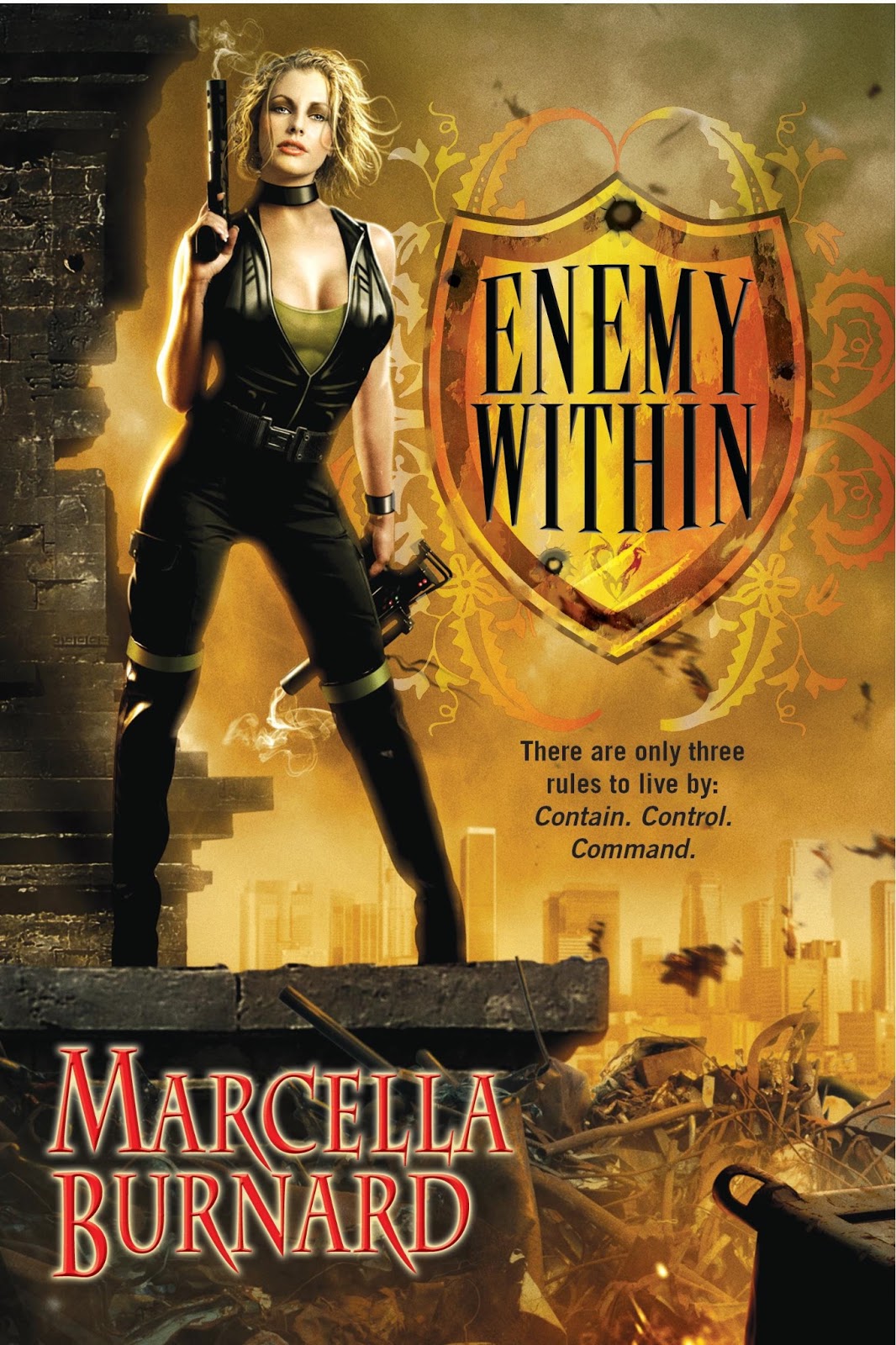
So when Berkley asked for some revision on spec on Enemy Within, the editor also tossed out - 'Hey, what do you think about making this a series?' I banged my forehead on my desk a few times and said, 'Let me give it some thought and see where I can go with it.'

That's my 'selling a series' advice. Don't want to sell a series and you're pretty much guaranteed that someone will ask for one. Here's the deal, though, and mark that I'm speaking in gross generalization: Most of the traditional NYC publishers like two book contracts. Or maybe it's the agents subbing to those houses who like two book deals so much. If you're asked for a series, don't expect it to go past two books *with that publisher*. Most publishers want amazing sales numbers right out of the gate and when they don't happen, your two book contract isn't likely to be renewed. This doesn't mean you won't write for that publisher again - you likely will be asked to submit something else. Something that isn't in the series or even the genre you sold originally.

Granted, thanks be to the blessed interwebs, you can subsequently self pub the rest of your series. I'll be doing this with the Enemy series
- since that two book contract story was, in part, mine. (Talk to any number of authors and you'll find it's a common story. Sometimes 2 books, sometimes more, but the end is usually the same - an orphaned series.)

Thus, some advice regarding your series.
1. No cliff hangers - you guarantee that the next book in the series will be declined and your readers will come after you with torches and pitchforks.
2. Complete your stories with each book - this goes with the cliffhanger thing in a way, but really, if you're writing romance, it's about completing at least that portion of the story within one book.
3. KEEP NOTES - series bible, a spreadsheet, whatever. Keep a list of characters, eye colors, place names, etc, so that if and when your series is orphaned, you have everything you need to keep going on your own if you so desire.

Thursday, July 18, 2013

Sequels and Series

by Allison Pang

I find myself in much the same boat as some of my fellow Word Whores this week, but for slightly different reasons.

Back in the early days of aspiring authorhood, I wrote my first Abby Sinclar story. In those days it looped the contest circuit as Shadow of the Incubus and was more of a paranormal romance. It even won a few of those contests- and I pitched it to several editors/agents at one of the RT or RWA cons.

And the thing is, agents and the like will tell you that you shouldn't pitch a series (at least aspiring writers, anyway.) You need to pitch or query a one-off book...with series potential. It's a rather frustrating line to walk sometimes. As writers, we have *plans*, dammit.

I had originally planned on seven books for Abby's series. Her Contract with Moria was supposed to be for seven years, and I figured that was a nice number to work with - but I only ever pitched it that way once or twice. Watching an editor's eyes glaze over made me realize it wasn't a selling point and I needed to change how I phrased things.

So I revamped it as more of a stand alone - it had an ending, but left the doors wide open for additional stories. I was already part-way through writing the second book when I sold the first...and two more.

This is where things got tricky. Like Jeffe mentioned in her post - having a series pre-written and be an awesome way to get things moving along, but you often don't know what the editor is going to have you change. In my case, the changes were substantial enough I had to scrap most of the 40k I'd already written and rework it entirely.

On top of that I had to come up with outlines for those next two mostly unwritten books for editorial approval. Making that first sale is a heady time - I was so incredibly grateful I'd sold anything, but for a panster like myself, the idea of having to actually plan out what I was going to do was very stressful.

But I'm a practical sort. My book deal was only for three books - and although I was excited about it, there was still a niggle in my brain going "What if they don't want any more after that?"

So I reworked the concept to fit into three books.  I supposed on one hand it's short-sighted - you like to think that what you're writing is worth something. But on the other, I didn't want to leave things unfinished. (And all this was before self-pubbing had taken off - I might have done things very differently these days. But back then, there weren't really many options.)

So, my three books were written and published, and I did come up with a concept for an option books/continuation of the Abby series (mostly focused on Melanie.). And the publisher decided to pass on that. (Which I suspected they would.)

Now, I do get a few emails a week asking if there are any more books coming - like Linda, I'm not quite done playing in this particular sandbox. There are still stories I want to tell and characters that need a chance to shine - and now I have far more options than I did years ago. I'm taking a little break from Abby now and working on something new, but I left the last book with a slightly ambiguous ending. I've seen various opinions from people on just who she ended up with or who the father of her baby was, and that's actually pretty cool with me.  (I had thought it was subtly obvious, but perhaps not.)

There's a good chance I'll self-pub those Melanie books - but if I don't, I like that people can decide for themselves how things worked out for that semi-happily ever after.

In the meantime, speaking of Melanie - the Carniepunk anthology drops on the 23rd (next week, huzzah!). For those of you missing Abby's world, you'll get a bit of a prequel to the series, involving Melanie and just how she got that magic violin of her. (Along with a cameo of a certain incubus and fallen angel, might I add.)

Wednesday, July 17, 2013

Serial Willing

I know we are on the "Selling a Series" topic this week, but currently I feel more qualified to provide warnings/insight/my experience with starting a series...and watching the opportunity to finish it evaporate.

I hadn't intended to write a series.
When I sold VICIOUS CIRCLE, I had no idea that JUNO BOOKS was being considered for a co-publishing deal with POCKET BOOKS. When the editor for JB informed me of this, I was also told a contract would be coming from PB. She didn't know what it would entail, as it was from them, not her. I assumed it would be a single book deal. When it came, it was a three-book deal.

Color me surprised. It was a dream come true. 

They wanted a little info on what the other two would be about.

I had to figure that out, too. I started working on an over-arching story idea spring-boarding from where VICIOUS left off. When I had it, when I got serious about the details needed to tell this story, I realized I would need eight books to tell it all. 

Sheesh. 

But I could at least give the publisher some idea of where I was going.

Honestly, I'm not sure what I gave them then because when I sat down to write, it didn't go as planned. I had cut so many characters from the first book, see, and they were all still in my head, fighting for some page-time like beauty queens backstage at a pageant. 

Heh heh heh. 

 So, I wrote a story that gave them all a little time, via a big "which witch will be in charge" pageant. HALLOWED CIRCLE kind of came out of nowhere. Which meant I'd need nine books to complete the story.

Opening in mid-October, the first three set the stage for the characters, maneuvers them into situations that tell you exactly who they are and what they are willing to fight for. Persephone has a big destiny. She has to be pushed into accepting the reality of it.

The second three books bring the three main characters to a shaky understanding that they must work together. It also shifts them around. For our heroine, the vampire who had status and power has lost it. Also for the heroine, the waerewolf who was avoiding status and power has stepped into the limelight. Both men have their weaknesses exposed. Seph has finally accepted what she is, and has seen people actually sacrifice their lives to save hers because of what she is. Everyone has lost someone they loved. The last scene of book six is the extended family of the main character at Thanksgiving dinner; they are all clearly changed since the opening. Barely six weeks of their lives have passed. 

Most importantly, the big-bad of the final showdown has been introduced.

In the final three books...things get serious.

So here I am, six books deep, and there is no contract to complete this tale.

I could scream and kick and cry. I could write a powerful, awesome synopsis of the final three books. It wouldn't make any difference. Publishing houses publish books, but they are a business. They love the story if it sells. If your numbers aren't good---even if they are low because your publisher had a major disagreement with a retailer who subsequently decided not to carry any non-guaranteed-best-seller releases which took affect in the month that your new release came out so at best your book only made it onto a scant number of shelves and basically the business side of publishing slaughtered your numbers (and many, many other authors' numbers) through no direct action of your own---there's no contract.
I get it. It wasn't personal; it was just good business.

They didn't say, "Linda you suck. You should give up on writing." It was more of a "Hey, sorry. You were in the wrong place at the wrong time. Better luck next time." But there are folks who want to know the rest of this story.

So I've taken a break from Seph's world. I've worked on other projects. Soon, I'll be back in her world. I've got to finish. For me. For those who write me the emails and message me on Facebook. Because I know the best parts of the story are these last installments. Because I believe in me.

I don't know where these last books will land. I haven't written them, let alone pitched them. But I know what will happen. And I can't wait to share the rest of the story.


Tuesday, July 16, 2013

Selling a Series: Preparing for the Ask

What, oh what, could I -- the un-pub -- possibly know about selling a series?

uhm... bupkiss


What do I imagine selling a series would require? 

~cackles~

Most of the stories I write are intended to be part of a series. It's not unusual for the original concept to actually be a book 2 or the final book. Long before I draft any manuscript in the series, I've a blurb in mind for what happens in the other books in the series.

Yes, yes, I am one of those writers who believes a series should have
 a definite end and constantly work towards that end.

The blurbs aren't that long -- no more than 250 words, a one-sheet, if you will. They include a summary statement for each of the following: the Setting, the Primary Cast, the Goal, the Motivation, the External Conflict, the Internal Conflict, and the Resolution.  I write those to aid me with seeding and maintaining the cart-horse-carrot order of events while I write the series.

I imagine other people on Team Buy KAK's Books would like those one-sheets to ... you know ... pre-sell the series to people who might want to pay for said series.

Imagination. It's a wonderful thing. 

However, to sort fact from fiction, ~snort~ I defer to the rest of my fellow Word Whores who have actually sold series. I'm as interested in the actual deliverable as you, my darling readers.

Sunday, July 14, 2013

How to Sell a Series When You're Not a Pre-Plotter

This is me with my granddaughter, Aerro, up in northern Wyoming last week. We all gathered to say goodbye to my Father-in-Law. It was bittersweet. Such a sad event, but also the largest gathering of the family possibly ever before or again. Daughter Lauren and Grandson Tobiah are playing on the jungle-gym in the background.

So, last week the Bordello was in rare near-consensus on the topic of outlining and how much we hates it, Precious. But what happens when you sell a series?

I mean, it's what we all want. Kind of the holy grail for writers, if we don't get to pick something like "have J.K. Rowling's career." For a long time (much longer than I liked), whenever my family asked me what I wanted for Christmas or my birthday, I'd reply "a lucrative, multi-book contract."

(Fortunately they love me and find me amusing, for the most part.)

The multi-book contract guarantees that the book you write will have a home - no worries about where or who you'll sell it to. It also provides a sense of creative continuity. If you sell three books in a series, then you know you'll have that time and space to tell the story at least over those books.

And there's the rub.

I might have gleefully misted my way through the first book, but those editorial types are all persnickety. They want to know what the OTHER books will be about, too. Thus this week's follow-on topic: Selling a Series: Concepts, Synopses, Outlines, and/or Manuscripts.

Now, some writers have all the books in the series already written. This can be fabulous for when that lucrative, multi-book contract lands in their laps. The rest of the series is already written and it's dead easy to tell the acquiring editor what happens next. There are two drawbacks to doing this, however. One is that the editorial direction on book 1 might change what happens in subsequent books, creating greater or lesser revisions. Not that this is a huge deal, but it's not a slam-dunk either. The second drawback, which is the major obstacle to me, is that you might never sell that series. I have one book still that hasn't sold and it may never do so. It's one thing to have invested in a single novel that never sells and another to have done so with two or three.

But that's my particular schtick - I hate "wasting time." Many authors would likely argue that writing a book is never wasted, whether it's pubbed or not. I tend to be goal-oriented.

So, let's say you sell that first book and score big - get that contract for two more - and those still need to be written. What happens next depends on the editor.

For me, I sold the first book in my Twelve Kingdoms trilogy, which was already written, and provided with it a "series sketch" of the next two books.

Wait, you say. What are you saying, Jeffe? Did you actually KNOW AHEAD OF TIME what the story would be before you wrote it??

 ~scuffs toe in the dirt~

Kind of?

KAK used the analogy last week of an outline being like an itinerary for a vacation. That's actually how I see it, too. However, KAK and I should likely never take a road trip together. Even though we'd have great conversations.

You all know that vacation type - the route is ruthlessly planned and timed, down to which eatery will serve for each meal. Me? I know pretty much where I'm going, but I hate being tied to a schedule. I'd rather enjoy the serendipity of discovery. Yes, that means sometimes we eat later than we like, sometimes at crappy places. It also means we end up in places we would never have known to plan on.

Thus, the series sketch has been my savior. With Twelve Kingdoms, I have three daughters of the High King and I know overall how their stories fit together. Did I know this when I wrote book 1? No no no. But, in writing the story of the middle daughter, the personalities and destinies - for want of a better word - of her sisters became more clear to me. Clear enough that I could write a paragraph that went essentially "now that we've ended up in New Orleans with a car load of antiques, we need to drive up to Delaware to sell them. But that won't give us the profit we're looking for, so we'll end up driving into Newfoundland."

Now, some editors, after buying a series on this kind of concept, then ask for outlines and synopses of those books. So far, my Kensington editor, Peter Senftelben, has not asked for that, for which I'm tremendously grateful. I think it's a vote of confidence that he knows I'll turn in a coherent novel. Even my other editor, Deb Nemeth at Carina, who bought Ruby on spec and a "synopsis" that was really more of a sketch - :D- and then asked me for a "more detailed synopsis," didn't come after me when I, um, didn't send it until I'd finished writing the story.

It's not that I don't *want* to cooperate and provide that detailed synopsis. It's just that I can't write one. It would be a lie. I know many writers do this - turn in an outline or detailed synopsis and then cheerfully deviate from it (as Linda suggested last week) - and I suppose I could, if pressed. I'd rather work with editors who understand my process and trust me to make it work.

And, fortunately, they love me and find me amusing. For the most part.

Thursday, November 8, 2012

The Neverending Story

by Allison Pang

When I was a kid, one of my favorite movies was The Neverending Story. I mean - it touched a lot of nerves for me - the bullied child getting a chance to become the Chosen One and enter a magic land.

But of course the real rub was the fact that once you started reading the book, your story became part of THE story...so it didn't end. (The Fushigi Yugi manga series was like this too.)

And the thing is, it's a really cool idea.

In theory.

In practice, though? Not so much. And that's not to say every book or story has to have *everything* completely wrapped up nice and neat - but most readers do want some sort of closure.

So how long is too long?

I guess there's no real answer to this either - each author and story is going to be different. Some books and series can seem to float on adventure after adventure - whatever it is that makes them appealing to readers has struck a perfect balance. People are creatures of habit after all - if they weren't, shows like "Murder, She Wrote" wouldn't have been on the air forever. (And we always KNEW how they would end more or less, right? Mystery solved, etc.)

And book series are the same way - look at all those Harlequins and their familiar tropes. There can be something very soothing about getting exactly what you expect, again and again.

For me - it just depends. Sometimes what makes a book or series that much more precious *is* the fact that it ends. I think it's far better to leave your readers wanting more than it is to watch your story fade away with a whimper.

And maybe part of that is planning. In general, I've found that authors with well planned out story arcs  tend to fair better, even if there are several books in the series. (Though certainly, I think we've all seen those authors who plan a trilogy...and then the story explodes on them and it becomes seven books - but again, so much of it depends on different variables. If the story arc does call for more books, wonderful - but if the author is padding each book with repetitious phrases and themes? That's when I start throwing hairy eyeballs.  (Looking at you, Robert Jordan. I couldn't get past the 9th book - just so much exposition and the same damn descriptions over and over and over again - e.g. women were always "planting their fists on their hips." I get that this is epic story-telling - The Odyssey does that too - dawn is always creeping in with rosy fingers and all that - but ancient stories were often meant to be told orally - totally different audience and the repetition was meant to help the listeners remember. Plus it was ONE story. Not fifteen 800 page epics.

At World Fantasy Con this past week, I sat in on a Charles de Lint reading and someone asked if there were going to be anymore Jilly Coppercorn stories (one of his more popular characters in the Newford books/short stories.) He's currently working on another story collection, but he said he wasn't sure about Jilly. He's actually been taking a break from writing Newford for a while because part of what made the Newford stories so interesting was the concept of hidden magic and how it intertwines within the lives of some of the people who live in the town. But where do you go when it starts to seem like *everyone* has a connection to this magic? It starts to lose some of its charm, I guess. Or at least maybe it becomes less special.

I found that to be very interesting -  he clearly knows what his story limits are. And he's not willing to forsake the integrity of writing those stories, simply to collect a paycheck. Which is a nice place to be - not all authors are that lucky - but there are certainly authors who get tempted to extend their series for several more books, even if their original plots didn't require that. And really - who *wouldn't* be tempted? Problem is that it doesn't always work out - and that's when it starts to seem like the author is phoning in the books, and reader dissatisfaction grows. Honestly, sometimes it seems like some of the super long running series have almost become fanfiction of their original selves. Like the only reason people read them is because they have a favorite character and plot doesn't matter at all.

*shrugs*

I wrote my current set of Abby books as a trilogy - but that was based more on practicality than anything else. I knew there wasn't any guarantee the publisher would want more  - and frankly, I had no idea how my books would be received when I first sold - so I attempted to set it up so that if there weren't any more, at least most of the plot threads would be tied up. Mostly because I wanted to leave some stuff open to pick up from, just in case. (And yes, I've got a proposal in for the option book(s) - but again, depending on if and when, I'll adjust my story arc accordingly, or look into self-pubbing if there's enough interest.) But even if I manage to pick up a few more books, I don't see myself writing the Abby stories forever.

New stories are waiting just past the horizon, after all - gotta give them a chance to be told.