Looks back over the week...tallies up the votes...and is not the least surprised to find the pay to play votes break right along genre lines. Anyone who's been a part of RWA has, to this point, been open to paying a contest entry fee. Conditioned? Yes. We are. For good reason.
RWA is unique among professional writing organizations in that membership is open regardless of publication status. The membership is tiered within the organization based on publication status, but the organization's goal is 'advancing the professional interests of career-focused romance writers'. That means that RWA welcomes writers of every level into the organization and then invests time and energy in teaching them anything and everything they want to learn about the craft and/or the business.
But, and this is a big 'but', there are no report cards, you know? If you're a writer still seeking publication, how do you garner constructive feedback from objective sources? Critique groups get to know you and your writing style fairly quickly - to the point that your crit partners can read between the lines of your writing and fail to call you on your BS. RWA's answer to objectively gauging your progress is contests. However, reading entries and commenting on their content takes time. Time is money. Therefore, in trade for someone else's time, contests within RWA charge a bit of money by way of entry fees.
So no, I have no issue with paying for contests. However. I will suggest that you should be very, very clear about what you're paying for when you fork over an entry fee. Before I was published, a contest had to promise me one of two things - feedback on the writing from someone who knew more than I, or a read by an editor/agent if I made the finals. The entire point of entering a contest was to find out where I needed to do more work on my craft and/or to get my work in front of an editor or agent and bypass the slush pile.
But just like kids grow up and graduate from high school, writers outgrow the need for contest as objective feedback loops. The RITA was the last contest I paid to play in and it was worth every penny just for the fun of it. But really, once a writer is published, feedback comes from agents, editors, critics, mothers . . . not kidding. Mom's single comment about my first book, "She swears a lot." Yes. Chick was a POW. She has reason to swear a lot. So no. I don't currently pay for contests.
To answer Jeffe's question from earlier in the week: Contests are a tool. Both for a writer's org and for the writer. Save the heaps of scorn for the writers and orgs that forget that fact.

Showing posts with label RWA. Show all posts
Showing posts with label RWA. Show all posts
Friday, April 15, 2016
Friday, April 8, 2016
Hunting Guide: Critique Groups, Where to Find and Bag Them
Critique partners (or groups) are like agents: good ones are worth their weight in gold. Bad ones are worse than not having one at all. By a long shot. But you've heard that all week long, right? So the question is: How do you find the mythical beast? The unicorn that is a good critique group? You have a few options.
- Meet Up - install the app and the search for writing groups. Chances are excellent that you'll find a number of writing groups meeting near you. Read through their descriptions and go check out a few. You get a 30 day trial before you have to commit to paying for anything. And you can try out several groups - go, talk to people, listen to what they're writing. Listen to HOW they talk to one another about writing. CAUTION: I did have a Meet Up writing group near me, but the group was more interesting in cheerleading than in making something better and they read snippets of work that were far too short to allow anyone to really work on story craft. So for my money, it wasn't a bad group, it just wasn't pointed in the direction I was going. Have an idea of what you're looking for when you go in.
- Your local library - chances are excellent that there's a local writers organization partnered with your neighborhood library. There may not be published critique meetings, but there are likely to be events like book signings that would allow you to begin talking to the writers and find out how to join the group. From there, you begin asking around about critique groups.
- Cons - Attending conventions aimed at what you write gives you access to people writing the same-ish genre. You'll find all kinds of organizations aimed at you. (Norwescon, my local scifi/fantasy con almost always has Broad Universe - the women in scifi - reps offering up membership info.) There are also a ton of writers and aspiring writers of every type there. Talk to them. Ask about critique groups. You never know.
- Writing Org Membership - Finding crit groups has been the greatest boon granted to me by RWA. My local chapter gave me my local critique group. My online chapter gave me the excellent critique partners I rely on as beta readers. It came from going to meetings, getting to know people, getting to know what they wrote and talking about wanting a critique group.


Sunday, February 15, 2015
Non-Human Antagonists (and I Don't Mean Aliens)

You know - now with topics like this week's: Antagonists who aren't villains - I start thinking more about what I studied back in the days of AP English than of my own work. Things like place as a character and antagonists who function as protagonists. Things OTHER writers do. My undergraduate and graduate degrees are in science, not literature. I am not one of those studied writers who plans out themes and symbology, who even thinks in terms of protagonists and antagonists.
It's funny because yesterday my local chapter of RWA, the fabulous Land of Enchantment Romance Authors (LERA), sponsored a program on using the Scrivener software, taught by Ben Prior. For those who don't know, Scrivener is a program many writers use for drafting and revising novels. It lets a writer compose by scenes and shuffle them around, combining and recombining, along with tracking metadata like setting and character profiles.
All of which makes my skin crawl.
Pretty much literally. In fact, my chapter mates know me so well that they teased me about it, asking at the end of the presentation if I was a convert. Anna Philpott, sitting next to me, burst out laughing and answered for me, saying no - that I'd been actually squirming in my chair in discomfort. Ben came over to me after and asked about my process. So I showed him my spreadsheets. ~eyebrow waggle~ And I explained that I don't think in terms of scenes or character profiles, that it's all one story to me, that I write from beginning to end.
And he said, "Oh, you're just one of those naturally talented storytellers."
So I'm clinging to that explanation, rather than the fraud one.
ANYWAY.
As I mentioned in last week's post about villains, I don't think I really write them. I suspect *most* of my antagonists aren't actually villains. Particularly in my contemporary romances, there aren't really villains at all. And the "antagonists" tend to be whatever it is in the protagonists that is stopping them from finding happiness. Their own stubbornness or blindness to what they need to see.
It's interesting to me, writing both genres. Particularly now, having just completed a final read of the galley proofs of my (very long) epic fantasy romance, THE TALON OF THE HAWK, and finishing and sending to my other editor the draft of my contemporary erotic romance, UNDER CONTRACT.
You'd think these two books would have little to no overlap and yet I noticed that they do. And it's in this arena - the antagonist who's not only not a villain, but not even a person.
Drought.
Yes, I have drought in both books, a relentless force that drives a great deal of the desperation to effect change. I did not plan it that way - or even notice until the other day - because (duh!) I don't plan any damn thing in my books. But it's there in both. No doubt a reflection of my life in the desert southwest of the US, where our ongoing severe drought has woven into the fabric of my subconscious.
I suppose my point is - since I really ought to have one - is that an antagonist can be any kind of conflict faced by the protagonist, whether human, alien, animal or a force of nature. Villains are a very small subset of antagonists, and fairly limited to certain subgenres. And, to my natural storytelling mind, among the least interesting variety. ;-)
 Jeffe Kennedy is a multi-award-winning and best-selling author of romantic fantasy. She is the current President of the Science Fiction and Fantasy Writers of America (SFWA) and is a member of Novelists, Inc. (NINC). She is best known for her RITA® Award-winning novel, The Pages of the Mind, the recent trilogy, The Forgotten Empires, and the wildly popular, Dark Wizard. Jeffe lives in Santa Fe, New Mexico. She is represented by Sarah Younger of Nancy Yost Literary Agency.
Friday, June 20, 2014
It's What You Know and What You Do With It
You know stuff. Yes, you do. It is highly likely that you have specific knowledge of something that would be of interest to someone else.
The first step for How To Put Up a Workshop: what do you know? It took me years to realize that while I am a character driven writer just like a bunch of other writers, I have a whole actor's toolbox at my back when it comes to handling characters - a toolbox I could open up and offer to other writers. Insta-workshop. A good friend is fascinated by the novel Peter Pan by J.M. Barrie. She has turned into the ultimate research geek for Edwardian fashion, manners, and ships/shipbuilding - not to mention her depth of insight into a single piece of literature. She has all kinds of workshop opportunities there. (Costuming/fashion, research resources for the time period, etc) Maybe you have a job you often see depicted inaccurately in fiction. There's your workshop. Or you have in depth insight into the mind of a serial killer because you've never, up until this very workshop, confessed that you are a serial killer. Whatever your knowledge, someone, somewhere needs it.
Second step for How To Put Up a Workshop: can you communicate your special thing in layman's terms? Part of the challenge of knowing what you know is that you know it. You take what you know for granted. Teasing apart what you know so that it's accessible to others is no easy feat. Solicit feedback from someone outside of your specialty field. A critique group can help. Or friends who know nothing about your deep, dark secret life. If it's the serial killer thing? I can't help. I'm busy.
Third step for How To Put Up a Workshop: pick your audience. Serial killer? I suggest that law enforcement might not be your ideal audience. The rest of you may have noticed I like cats. Hanging out with the cat fancy, I can say I have picked up a fair bit of information about the genetics of feline coloration. Specialized knowledge that's utterly useless to just about everyone else on earth. Knowing that my workshop audience(s) are likely to either be writers or steampunk enthusiasts, I have to realize nobody else cares that genetically speaking there's no such thing as a brown and white tabby cat. Unless I'm making a point of coming up with a mad scientist aboard and airship somewhere who's doing the impossible with gene splicing brown and white cats with machine components. Your audience is likely going to be determined by the conferences and meetings you already attend. Most of us are going to develop workshops for writers or for readers. But what other events do you attend? Our marina brings in speakers on subjects specific to boaters - crossing the Atlantic, managing storms at sea, circumnavigating Vancouver Island or cruising the canals of France. . .match what you know with who might be intrigued by what you know. Check your local libraries. Don't limit your audience. What you know may be applicable more than one place, which brings us to:
Fourth step for How To Put Up a Workshop: develop for more than one format. If you belong to RWA, you have amazing opportunities for putting on your workshop in multiple formats. You can teach your workshop online via a series of lessons you write out and then interactive emails with participants. Do this through your online chapters. You can present your workshop at your local chapter meeting. You can submit your workshop proposal to a local conference. Last but not least, you can submit your proposal to the National conference.
NOTE: while I echo the advice that interactive workshops are really helpful, don't think you'll get people out of their chairs to participate in actual movement once you reach local and national conference levels - everyone is in nice clothes and shoes. Interactive at that point means getting workshop participants to talk to you and/or share writing.
The first step for How To Put Up a Workshop: what do you know? It took me years to realize that while I am a character driven writer just like a bunch of other writers, I have a whole actor's toolbox at my back when it comes to handling characters - a toolbox I could open up and offer to other writers. Insta-workshop. A good friend is fascinated by the novel Peter Pan by J.M. Barrie. She has turned into the ultimate research geek for Edwardian fashion, manners, and ships/shipbuilding - not to mention her depth of insight into a single piece of literature. She has all kinds of workshop opportunities there. (Costuming/fashion, research resources for the time period, etc) Maybe you have a job you often see depicted inaccurately in fiction. There's your workshop. Or you have in depth insight into the mind of a serial killer because you've never, up until this very workshop, confessed that you are a serial killer. Whatever your knowledge, someone, somewhere needs it.
Second step for How To Put Up a Workshop: can you communicate your special thing in layman's terms? Part of the challenge of knowing what you know is that you know it. You take what you know for granted. Teasing apart what you know so that it's accessible to others is no easy feat. Solicit feedback from someone outside of your specialty field. A critique group can help. Or friends who know nothing about your deep, dark secret life. If it's the serial killer thing? I can't help. I'm busy.
Third step for How To Put Up a Workshop: pick your audience. Serial killer? I suggest that law enforcement might not be your ideal audience. The rest of you may have noticed I like cats. Hanging out with the cat fancy, I can say I have picked up a fair bit of information about the genetics of feline coloration. Specialized knowledge that's utterly useless to just about everyone else on earth. Knowing that my workshop audience(s) are likely to either be writers or steampunk enthusiasts, I have to realize nobody else cares that genetically speaking there's no such thing as a brown and white tabby cat. Unless I'm making a point of coming up with a mad scientist aboard and airship somewhere who's doing the impossible with gene splicing brown and white cats with machine components. Your audience is likely going to be determined by the conferences and meetings you already attend. Most of us are going to develop workshops for writers or for readers. But what other events do you attend? Our marina brings in speakers on subjects specific to boaters - crossing the Atlantic, managing storms at sea, circumnavigating Vancouver Island or cruising the canals of France. . .match what you know with who might be intrigued by what you know. Check your local libraries. Don't limit your audience. What you know may be applicable more than one place, which brings us to:
Fourth step for How To Put Up a Workshop: develop for more than one format. If you belong to RWA, you have amazing opportunities for putting on your workshop in multiple formats. You can teach your workshop online via a series of lessons you write out and then interactive emails with participants. Do this through your online chapters. You can present your workshop at your local chapter meeting. You can submit your workshop proposal to a local conference. Last but not least, you can submit your proposal to the National conference.
NOTE: while I echo the advice that interactive workshops are really helpful, don't think you'll get people out of their chairs to participate in actual movement once you reach local and national conference levels - everyone is in nice clothes and shoes. Interactive at that point means getting workshop participants to talk to you and/or share writing.
Friday, May 23, 2014
Should You? When to Con
 Do you have a completed manuscript? Go to an RWA sponsored convention. It need not be National, though if you're a member of the organization, you should do that at least once in your life. The point is to put yourself in the same room as the editors buying books and into the same room as the agents who might represent the type of book you wrote. Several RWA chapters put up conventions. Check to find out whether there might be one close by. Then avail yourself of every workshop and learning opportunity you can. Also, there may be costume parties.
 It was at RWA conferences that I learned the difference between internal and external conflict. It's where I learned I wasn't a plotter and that there was no faster way to take the joy out of writing than to attempt to be a plotter. I found mentors. Above all, and best of all, I made great friends at conferences. My sharpest critique group is made up of women I met at conferences. The first request I ever had for a partial happened at a local conference. An editor asked for the first three chapters. And when she rejected them, she kindly gave me some insight as to why. The first person to request a full manuscript was an agent I'd met at a conference. (She rejected the book and also gave me some feedback - something she wasn't obligated at all to do and which I appreciated enormously.) So, yes. Cons. 100% worth the time, effort and introvert dread - IF when someone requests pages, you actually SEND them.
However, all that said, I didn't find an agent at a conference. I did that by spamming every agent on the RWA agent list who even intimated he or she might read science fiction. There were nine. One of them read my sample pages, requested the full, read it over Easter weekend, and called me Monday morning. When my first book sold, it sold to an editor I'd never met. (Though later I did get to meet her in person - at a con.) Point being that if you cannot get to a convention, don't stress it. Makes no difference to the people who'll rep and/or buy your book. Do I think I got my work into shape faster because of cons and the workshops? Yes. But if you're taking workshops, trying new things in your writing, getting feedback on your work, and doing your damnedest to incorporate the feedback that makes sense to you? You're in good shape, don't sweat the conference.
Is there a time I'll urge you to pull every stop and get your butt to a conference come hell or high water?
 There is. Once you're published, if you final in the RITA, go to National. Don't care what it takes. When I was lucky enough to final, it was the summer my husband and I were sailing the Inside Passage for five months. We were headed north into unbroken wilderness. I say unbroken wilderness and I mean 'no airport for hundreds and hundreds of miles'. To get me to the conference that year, we turned around so I could fly to NYC. Where I won absolutely nothing. But where I had the time of my life. If you final in the major contest for your genre, you are a princess (or a prince) for the duration of the conference where the winners are announced. People will see your finalist pin and ribbon and whether they know you or not, will ask for the story of how the book got published and what happened when you found out it was a finalist. Your editor and your agent, if you have one, will likely be at that conference. You'll sit with them at the finalists table at the awards banquet. You get nifty little 'finalist' flags for your spot at the great big book signing. Just for the number of people I got to meet and talk to - I will never regret interrupting the trip of a lifetime for the conference of a lifetime. Maybe my husband, who was trapped in Victoria Harbor for Canada Day and fireworks regrets it a tiny little bit, but he was also three blocks from his favorite chocolate store in the whole wide world. He doesn't seem to hold much of a grudge. :D
Sunday, August 4, 2013
Most Effective Marketing for the Pre-Published Writer

This is me and the lovely, sadly former, Word Whore at the Kensington Author Cocktail Party at the Romance Writers of America (RWA) National Conference a few weeks ago. Amusingly, James Tuck, another former Word Whore was also in attendance, but I didn't get a pic with him. Too bad, because he's got to be twice my size - it would have been a funny photo. At any rate, it was practically a Word Whores conclave and, as we all know that the Word Whores have exceptionally high standards for wit, insight and sheer ballsyness (yes, that's a word, Blogger), that makes for great conversation.
At any rate, this week’s topic is Word On the Street: Most Outrageous (Yet Effective!) Marketing Plan For The Not-Yet Famous. Since there’s an exclamation point in this, I feel quite certain Carolyn suggested this topic, before she had to move on to less busy pastures. For some reason, when I first read this topic, to mull over my take on it, I understood it as “not yet published.” I see now that it’s “not-yet famous,” which is, um, pretty much every damn one of us who isn’t Stephen King, Stephenie Meyer or J.K. Rowling.
But that’s neither here nor there and I shall let my fellow whores weigh in on their takes.
I’m running with the “not-yet-published” aspect, not just because that’s what I mentally prepared, but because I think I have good advice.
Of course, I always think that.
My advice even counts as outrageous, because I think it’s something that doesn’t occur to most people:
Volunteer to be President of your local or special interest writing chapter.
Seriously.
Now, maybe this advice is tailored more for the romance writers, because RWA has local and special interest (read: online) chapters. Organizations like Science Fiction Writers of America (SFWA), while they have informal regional gatherings, don’t have chapters in the same way. Even if they did, SFWA doesn’t embrace the pre-published authors in the same way as RWA does, so the point is pretty much moot.
So, here’s my story. Back in the day (2008), when I was shopping the book that became Rogue’s Pawn, I joined RWA for one reason and one reason only – so I could attend the RWA National Conference and personally pitch to an agent and editor. I was naïve enough then that I truly believed that this was all I needed to do to sell my book.
(Yeah, you can take a moment to shake your heads sadly.)
I knew Not One Person there and, after I pitched and got my requests, I celebrated at the bar by myself with a glass of champagne. Sad and pitiful, I know. But I felt okay about it because I knew the agent and editor would read my manuscript, offer me a lucrative, multi-book contract. Then, I figured, I’d return to the conference the next summer – because the enormously high quality of the key-note and awards ceremony speeches, along with the workshops and panels had so impressed me – as a legit romance author and make friends then.
It could have been the champagne.
Of course, we all know how this story turned out. Both the agent and editor, to my astonishment, passed on the book. At loose ends, I took a couple of online workshops (I lived in the wilds of Wyoming at the time) and looked for help. One gal suggested I join the Fantasy, Futuristic and Paranormal (FFP) special interest chapter (online, naturally), for advice and support. Best advice ever.
Shortly after I joined up, calls went out for a new board. No one stepped up to be President and the pleas for a volunteer grew increasingly strident. I finally said, hey, total newbie here, but I’m willing, and they snapped up my offer with scary speed. I ended up serving two years as Prez of FFP and I still sit in on board meetings as Past President, for continuity.
The astonishing part was when I attended the RT Booklovers Convention the following spring and then the next RWA Conference. Suddenly, everyone knew who I was! The published members of FFP hugged me on sight, took me under their wings and introduced me to their agents and editors. They, and other agents and editors, took me more seriously. When I pitched, we started out talking about FFP and what the chapter did. Serving on that board gave me an entrée that I’d lacked the previous year. I met my first critique partners (CPs) through FFP, several of whom are still my CPs and good friends today.
Even now, some of my best connections are ones I made by serving as President of that chapter. Because I gave to them, all those wonderful people wanted to give back to me.
And it’s made all the difference.
Jeffe Kennedy is a multi-award-winning and best-selling author of romantic fantasy. She is the current President of the Science Fiction and Fantasy Writers of America (SFWA) and is a member of Novelists, Inc. (NINC). She is best known for her RITA® Award-winning novel, The Pages of the Mind, the recent trilogy, The Forgotten Empires, and the wildly popular, Dark Wizard. Jeffe lives in Santa Fe, New Mexico. She is represented by Sarah Younger of Nancy Yost Literary Agency.
Sunday, July 21, 2013
Scenes and How They Do and Don't Work in Novels

So this week's topic is Scene Goal: Why YOU Should Have One (Pantsers Beware!). No doubt it was KAK, calendar Nazi and avowed pre-plotter who added that snide addendum for Pantsers to beware. No doubt directed at me.
Ha ha.
But it's interesting, having just come back from the convention, and hearing so many amazing workshops on craft and business. So many writers talked about various approaches to writing that involve blending of plotting and pantsing that it makes me think there are very few of us - if anyone - who does all of one thing or the other.
The whole idea behind making sure that you, as the author, have a goal for every scene is to keep the writing tight, focused and moving forward. The primary definition of a scene comes from theater, as so many of our writing craft concepts do.
Thank you ancient Greeks, yet again!
So a scene is, first and foremost:
1: one of the subdivisions of a play: asa : a division of an act presenting continuous action in one placeb : a single situation or unit of dialogue in a play <the love scene>c : a motion-picture or television episode or sequence
In theater they are usually delimited by the entrance and exit of characters, because that dynamic movement is such a driving force for a stage play. Many movies have adopted the sense of a scene break - moving fast from one visual to another - to drive action forward. In network TV, scenes are broken up by commercials.
This can be less clear in a novel, because characters don't necessarily physically come and go, conversations and actions may flow more seamlessly from one point to another, and there are no commercial breaks. (We hope!)
People who use screenwriting models to structure their novels tend to move scene by scene. However, though I use the Three-Act structure and find it very useful, I rarely think in terms of scenes, or scene goals. This is not because I write for discovery, pants, mist or whatever you want to call it.
It's because I'm a character-driven writer.
See, the common wisdom - and it's generally good information - is to follow the Goal-Motivation-Conflict model. This largely comes from Debra Dixon's book on the topic, which many writers, especially new ones, seem to like very much.
It does nothing at all for me.
To me, characters are real people. They're complex, which means they're muddled. It makes a clean story for a character to have a single goal for every scene, to be driven by their motivation to overcome the conflict. We used this in theater all the time. But that's only the most fundamental level. Do any of us have only one goal or motivation at a time?
Think about yourself, right at this moment. You're reading this post. What's your goal? Your motivation? Is there a conflict? Maybe not and you reading this wouldn't make a very good scene or story. But, placed in the larger context, reading this might be part of the goal to be a better writer, motivated by your deep-seated dream and the desire to overcome that last rejection.
But, if I'm writing your story, I want to show how you're feeling, whether you think this makes sense or not, and then throw in a symbol of whatever is truly holding you back - that maybe you don't even realize. You start thinking about maybe playing Solitaire instead or your crying child comes in saying you don't pay enough attention to her, or your spouse grumbles about wanting you to cook something.
What's my goal for your scene?
Not a neat tick on the outline. Not an easily encapsulated 1, 2, 3. Instead I'm painting one piece of a puzzle. Hopefully by the end, it will make for a complete image.
I suspect this is the heart of pantsing. Not that we don't pre-plot, but that we don't always have a trajectory that can be mapped like a vector equation. Maybe we're the impressionists of the writing world. The rules matter less to us than the FEEL.
In fact, one of the best workshops I went to at the conference was about intensifying emotion. Tanya Michaels gave us many great examples of how some great books do this. Most valuable to me, she said "if you can make your reader feel one emotion, you can make them feel all the emotions." Loved that.
I suppose what I'm getting at is, not every emotion has a goal. Sometimes a scene is there just to create a mood. Perhaps one could argue with me that creating a mood IS my goal, but I don't always know that.
And I don't think I have to know.
But then, I'm happy in the misty worlds.
Jeffe Kennedy is a multi-award-winning and best-selling author of romantic fantasy. She is the current President of the Science Fiction and Fantasy Writers of America (SFWA) and is a member of Novelists, Inc. (NINC). She is best known for her RITA® Award-winning novel, The Pages of the Mind, the recent trilogy, The Forgotten Empires, and the wildly popular, Dark Wizard. Jeffe lives in Santa Fe, New Mexico. She is represented by Sarah Younger of Nancy Yost Literary Agency.
Sunday, November 18, 2012
Ten Things I'm Thankful for in My Writing Career - a Retrospective

This week, appropriately enough, given that it's Thanksgiving in the US, we're giving thanks particularly about our writing careers. This should be a pretty easy list to make, though determining the scope is less straightforward. I'm realizing just now that it's been twenty-one years since I attended the Society for Neuroscience Convention in New Orleans, melted down and faced the fact that I didn't really want to be a neuroscientist. Which was inconvenient, since I was three years into a PhD program at that point. That's also the year (coincidence?) that David and I started dating--a brief fling that's still going strong. I didn't know at the time what a pivotal year that would be for me.
Maybe we never know these things at the time.
So, without further ado, I'd like to give thanks that:
1) the universe gave me such an interesting answer when I asked what would be the perfect career for me.
2) I was surrounded by the warm and wonderful writing community at the University of Wyoming, who welcomed me in and offered me the tools I needed to grow into being a writer.
3) David supported me from the very beginning and even remodeled the old coal bin for me, so I could have a place to write.
4) I found a series of jobs and appreciative bosses who let me fiddle with my work schedules.
5) there are so many opportunities to send my writing into the world, from tiny university literary journals to magazines to anthologies to book publishers, digital and traditional, great and small - all staffed by extraordinary, dedicated people who love a good story.
6) there are also so many fine organizations to support writers - like the Wyoming Arts Council, the Ucross Foundation, Romance Writers of America. They were there for me when I got started
7) there is the fabulous, interconnected, multi-faceted beast the internet community has become. ~presses nose to screen~ All my friends are in there!
8) so many readers are so generous with their love of books. All those book bloggers who spend the equivalent of part-time, or even full-time, jobs writing reviews and talking up their favorite authors. All the people who take the time to post ranks on Goodreads and stars on Amazon, who tweet, email and Facebook message just to say that they loved a book.
9) that I live such a blessed life, that I get to spend my time doing this. That I am not living in a war zone, am not poverty-stricken, that I have the civil rights to write whatever I please, that I don't have to worry about my basic survival.
10) the universe gives us stories to tell in the first place.
Happy Thanksgiving everyone!
Jeffe Kennedy is a multi-award-winning and best-selling author of romantic fantasy. She is the current President of the Science Fiction and Fantasy Writers of America (SFWA) and is a member of Novelists, Inc. (NINC). She is best known for her RITA® Award-winning novel, The Pages of the Mind, the recent trilogy, The Forgotten Empires, and the wildly popular, Dark Wizard. Jeffe lives in Santa Fe, New Mexico. She is represented by Sarah Younger of Nancy Yost Literary Agency.
Sunday, July 29, 2012
Tainting Sci Fi and Fantasy with Girl Cooties

Yes, it was fabulous.
And, yes, I'm exhausted.
But RWA - Romance Writers of America - is my home territory. This was my fifth year going and I've been heavily involved in my special interest and local chapters. Plus, it's pretty much all girls. There's a few guys here and there, but functionally it's 2,000 women involved in some branch of romance writing and publishing.
It's really the only thing I do that's like this. Maybe it's akin to the old sorority days, but this is better because it's so profession and career-focused. They are my tribe.
In November, I plan to go to World Fantasy Con, which will not be like this. In fact, my smart friend advised me not to go. "They're not your audience," she told me. And then she told me several stories about female authors being harassed at the more hard core science fiction and fantasy conventions. I thought about this and decided that they won't be my audience if they never meet me.
I'm a little nervous though.
It reminds me of the old Dennis the Menace joke - the clubhouse with the "No Girls Allowed" sign. My feelings date back to my own childhood. That awful phase we all went through, when the boys decided that all girls had cooties (an indefinable, icky, yet dreadfully contagious thing) and that we were something to be disdained.
(Much later in life I discovered that "cooties" actually referred to head lice, but we never knew this as children. Nobody could ever tell me what a cootie was.)
I know there's lots of psychology behind this. The boys were distancing themselves from their mothers and moving into the world of men. They needed to create distance to cement their developing masculinity. But I also recall my teachers telling us about studies showing that, while girls could see themselves as boys, boys could not see themselves as girls.
The message was quite clear that being a girl just wasn't as good.
But hey - we all grew up, right? The boys rediscovered the girls and all the lovely thrill and magic of blending ourselves. And it turned out that some of the boys wanted to be girls enough to have operations to get there. Nothing was so black and white.
Still, there remains a contingent of boys who seem to be guarding the ever more rickety clubhouse. They don't want girls writing SFF and getting all that sticky, kissy shit in it. Except for maybe the Ginas, who don't act like real girls anyway. It's more okay if a girl author writes kick-ass stuff. But if we're the Margarets, starry eyed over love and romance? We are emphatically sent home, with ridicule chasing us down the street.
It's significant, I think, that I'm using an analogy that dates back to 1952. The world has changed a great deal since then. Change, however, happens in fits and starts, with little backwater stagnant pools that get left behind. Eventually those pools dry up. Or get washed into the fast-moving water of the greater flow.
Last night, a Carina Press book won RWA's RITA award. This is RWA's version of the Oscars and this marks the first time a digital press has won the award. (Another epress, Avon Impulse, also had an award winner.)
The world turns and times change.
I first read that line in Anne McCaffrey's book Dragonflight, one of the seminal SFF books, series and authors out. The line is a recurring theme and it became part of my frame of reference.
We aren't kids on the playground anymore. No one has cooties.
And the clubhouse is big enough for everyone.
Jeffe Kennedy is a multi-award-winning and best-selling author of romantic fantasy. She is the current President of the Science Fiction and Fantasy Writers of America (SFWA) and is a member of Novelists, Inc. (NINC). She is best known for her RITA® Award-winning novel, The Pages of the Mind, the recent trilogy, The Forgotten Empires, and the wildly popular, Dark Wizard. Jeffe lives in Santa Fe, New Mexico. She is represented by Sarah Younger of Nancy Yost Literary Agency.
Sunday, July 22, 2012
How to Improve the Discoverability of Books

(Yes, those are PRISM trophies, for those of you hoping to win one next week!)
Otherwise, those are boxes of bookmarks, business cards, special candies to give away and so forth. There's one reason I do all of this: to call attention to the books. I mean, I go to convention for a number of reasons: networking, rejuvenation, learning. But I could do all that empty-handed. No - the stuff is for discoverability.
And, yes, that really is a word. Now.
It's only become a word in these tumultuous post-paper, post-brick and mortar bookstore days. Oh sure, there are still paper books and libraries and book stores, but these venues are on the decline. Far fewer bookstores are available, even fewer are ones you could go into and have someone passionate about books hand sell you something you're sure to love. And there are all those so-convenient eReaders, which allow you to buy your next read from wherever you happen to be, with the click of the buy now link.
In the old days, the publishing house might have sent the author on tour. The gung-ho author would forge relationships with those hand-selling book lovers. For many years, publishing houses sold books to bookstores, not to readers. It's an important distinction. Publishers knew how to sell to bookstores and then those stores took care of selling to readers.
Thus the consternation in the publishing and book-selling community. In the electronic jungle, how do readers discover those new books to read? Lots of conversations on "improving discoverability," which really means "how do I get them to buy MY book?"
My take on that? I don't think you do.
I heard a great quote recently, when Susan Elizabeth Phillips spoke of what a generous and gracious person Sandra Brown is. (Fair warning: Sandra's website has flash, takes forever to load and has sound - dunno WHAT they're thinking on that!) Sandra said it's because "A high tide floats all ships."
This, to me, is the essence of social media. And of finding the path through the jungle.
We're no longer lone authors hidden away in our secret lairs, venturing out on pre-planned quests to woo booksellers. We're part of a web - a vast network of writers, editors, agents, publishers, book bloggers, readers and book sellers. The high - or low - tides affect us all. Everybody wants to sail their ships.
So, the people who get on the internet and shout BUYMYBOOK BUYMYBOOK BUYMYBOOK are not improving their discoverability. In fact, people are likely to turn their backs and put their fingers in their ears. No - it's about conversations and being passionate about books. All books. In some ways, we're all hand-selling books theses days. And that's about sharing the love.
I discovered this for myself just recently. The Bookpushers Blog (and boy, are they well-named) did a joint review of Rogue's Pawn. And now they talk up and recommend the book all the time. Because they loved it. People who like them and their blog get excited and pick it up, too. This kind of thing is what our community is about. More - it's so fun.
Okay - so how did Bookpushers discover the book? Netgalley.com, which lists books available for review in digital format. Why did the reviewer first pick it out - pretty cover? Compelling cover copy? Fabulous title? Hard to say. Serendipity, perhaps.
But my point - and I do have one ;-) - is that we maybe should spend less time talking about how to improve discoverability and more time just talking about books.
After all, that's what we love best.
Jeffe Kennedy is a multi-award-winning and best-selling author of romantic fantasy. She is the current President of the Science Fiction and Fantasy Writers of America (SFWA) and is a member of Novelists, Inc. (NINC). She is best known for her RITA® Award-winning novel, The Pages of the Mind, the recent trilogy, The Forgotten Empires, and the wildly popular, Dark Wizard. Jeffe lives in Santa Fe, New Mexico. She is represented by Sarah Younger of Nancy Yost Literary Agency.
Sunday, July 3, 2011
Then and Now
 by Jeffe Kennedy
I'm writing this from an airport, returning from the RWA convention in Times Square. The week, as always, was fulfilling, brilliantly fun and utterly exhausting.
This was my fourth time to attend this conference. It's become a bellweather for me. This annual event marks the flows and tides in my writing career. Every bit of it contains a patina of previous years, a kind of layering of the passage of time.
The first year, I went alone. I knew not one person at that huge event in San Francisco. I attended mainly to pitch, full of certainty that I would succeed. I stayed in a room by myself, ate by myself. Drank a glass of champagne alone at the bar, celebrating my first successful pitches and requests.
The manuscripts were later rejected.
The second year I returned as president of an online chapter. I suddenly had a roommate and scheduled activities along with my pitch sessions. I met many more people, felt more confident, received more full requests. Which were also rejected.
Last year it seemed I knew everyone. Every walk felt like homecoming week, filled with good friends. I thought two agents would love my new novel. One avoided me and the other slapped me down so hard and treated me like dirt beneath her feet, that I cried afterwards.
This year, I didn't pitch. Instead I met with an interested agent in the bar and we talked about some revisions to that no longer quite so new novel. It was fun and relaxed. When she found me at a party, she kissed me on the cheek. I went to the Harlequin party at the Waldorf-Astoria - possibly the best party I've been to in my life. There I chatted with another agent who has my manuscript - but about movies and wine. Then the agent who'd taken me down the previous year came over. She wanted to dance. Everyone was dancing, in stocking feet. The two of them pulled me onto the dance floor, then high-fived me after.
It's funny how things roll around. I talk to the up and coming writers and give advice where I can. I know next year, or the year after, they'll be dancing at the party, too.
It just takes a little time.
Jeffe Kennedy is a multi-award-winning and best-selling author of romantic fantasy. She is the current President of the Science Fiction and Fantasy Writers of America (SFWA) and is a member of Novelists, Inc. (NINC). She is best known for her RITA® Award-winning novel, The Pages of the Mind, the recent trilogy, The Forgotten Empires, and the wildly popular, Dark Wizard. Jeffe lives in Santa Fe, New Mexico. She is represented by Sarah Younger of Nancy Yost Literary Agency.
Sunday, April 17, 2011
Hi, I'm Jeffe and I'm a Shoe Whore
by Jeffe Kennedy

I never really considered myself much of a shoe whore.
No, no - don't scoff. I really didn't. I never really "got" the jokes about shoe-shopping. I didn't splurge huge amounts of money on shoes. I never guiltily or proudly confessed the number of shoes I owned - or really knew how many I had.
But I do wear heels. I love to wear heels. Thigh-high black leather boots? Oh yes. Strappy, high-heeled sandals? Sign me up. Gorgeous pair of buff suede high-heeled boots on deep sale at DSW? Oh yes yes yes!
I like clothes in general and a great pair of boots or shoes can make an outfit. I still didn't consider myself much of a shoe whore.

Then a couple of things happened, a few years back.
The gals I worked with and traveled with one- to two- weeks out of every month teased me that they could hear me coming down the hall, by the click of my heels. I arrived a day late to a trip and walked into the conference room to discover they'd all laid bets on what kind of heels I'd be wearing. My boss had described me to a person who'd never met me as "someone who doesn't own a pair of tennis shoes." I wasn't sure what to make of that and she said, "well, do you?"
I didn't.
(Since then I've started running on the treadmill, so now I do. So there.)
Then I went to my first RWA conference. A gal stopped me in the hallway and took a picture of my shoes. She put the photo up on her blog. It was a very special welcome to my new tribe - especially poignant because I knew NO ONE at that conference. A year after that, my twenty-something stepdaughter, Lauren, gave me a pair of heels for Christmas. Red. VERY high heels. With platforms. My first thought was, how young does she think I am? My second thought was, I *love* these shoes! So, apparently she knew me better than I knew myself, which is the best gift of all.
Then there was an incident wherein I became obsessed with having a pair of high-heeled Mary Janes. Yeah, I know. No life is complete without a pair of those. That particular photo is the only one I had to take to put up this blog post. That tells us something right there, I suppose.
I'm coming to terms with who I am.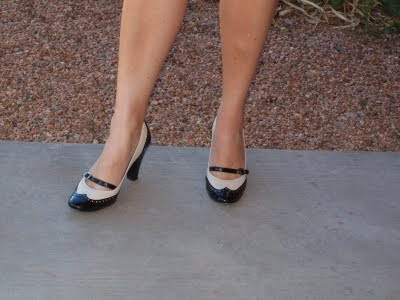
I blame Twitter, really.
Since all we talk about is shopping and what we ate for breakfast, if I mentioned I bought, or even like, a pair of shoes, they demand pics. It's what tripods are for, no? And the Zappos folks are smart about Twitter. One of the best examples of corporate use of social media that I've seen.
 I still don't have all that many pairs of shoes, really. I'm no Imelda Marcos, by any stretch. But at RWA last year, Nora Roberts checked out my outfit and totally gave me the nod of approval.
High praise, for any shoe whore.

I never really considered myself much of a shoe whore.
No, no - don't scoff. I really didn't. I never really "got" the jokes about shoe-shopping. I didn't splurge huge amounts of money on shoes. I never guiltily or proudly confessed the number of shoes I owned - or really knew how many I had.
But I do wear heels. I love to wear heels. Thigh-high black leather boots? Oh yes. Strappy, high-heeled sandals? Sign me up. Gorgeous pair of buff suede high-heeled boots on deep sale at DSW? Oh yes yes yes!
I like clothes in general and a great pair of boots or shoes can make an outfit. I still didn't consider myself much of a shoe whore.

Then a couple of things happened, a few years back.
The gals I worked with and traveled with one- to two- weeks out of every month teased me that they could hear me coming down the hall, by the click of my heels. I arrived a day late to a trip and walked into the conference room to discover they'd all laid bets on what kind of heels I'd be wearing. My boss had described me to a person who'd never met me as "someone who doesn't own a pair of tennis shoes." I wasn't sure what to make of that and she said, "well, do you?"
I didn't.
(Since then I've started running on the treadmill, so now I do. So there.)

Then I went to my first RWA conference. A gal stopped me in the hallway and took a picture of my shoes. She put the photo up on her blog. It was a very special welcome to my new tribe - especially poignant because I knew NO ONE at that conference. A year after that, my twenty-something stepdaughter, Lauren, gave me a pair of heels for Christmas. Red. VERY high heels. With platforms. My first thought was, how young does she think I am? My second thought was, I *love* these shoes! So, apparently she knew me better than I knew myself, which is the best gift of all.

Then there was an incident wherein I became obsessed with having a pair of high-heeled Mary Janes. Yeah, I know. No life is complete without a pair of those. That particular photo is the only one I had to take to put up this blog post. That tells us something right there, I suppose.
I'm coming to terms with who I am.

I blame Twitter, really.
Since all we talk about is shopping and what we ate for breakfast, if I mentioned I bought, or even like, a pair of shoes, they demand pics. It's what tripods are for, no? And the Zappos folks are smart about Twitter. One of the best examples of corporate use of social media that I've seen.
 I still don't have all that many pairs of shoes, really. I'm no Imelda Marcos, by any stretch. But at RWA last year, Nora Roberts checked out my outfit and totally gave me the nod of approval.
High praise, for any shoe whore.
Jeffe Kennedy is a multi-award-winning and best-selling author of romantic fantasy. She is the current President of the Science Fiction and Fantasy Writers of America (SFWA) and is a member of Novelists, Inc. (NINC). She is best known for her RITA® Award-winning novel, The Pages of the Mind, the recent trilogy, The Forgotten Empires, and the wildly popular, Dark Wizard. Jeffe lives in Santa Fe, New Mexico. She is represented by Sarah Younger of Nancy Yost Literary Agency.
Subscribe to:
Posts (Atom)